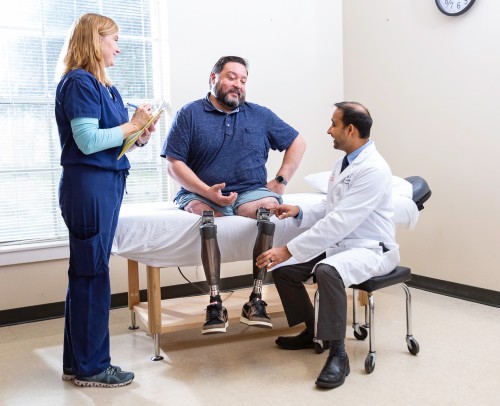
 TIRR Memorial Hermann has become a national leader in the use of osseointegration (OI), a novel approach that offers patients with limb loss an alternative to traditional, socket-based prosthetics, which can cause discomfort and be difficult to use.
The surgical procedure, in which patients are fitted with a bone-anchored prosthesis, is particularly beneficial for those with bilateral above-knee amputations.
“Osseointegration is an innovative technique that optimizes prosthetic fit and function, and it is a real game changer for some patients with limb loss,” says Vinay Vanodia, MD, medical director of the Amputee and Limb Loss Rehabilitation Program at TIRR Memorial Hermann.
“It’s a bone-anchored prosthesis, which provides a more secure attachment to the body compared to traditional socket fits, eliminating the risk of it slipping off. Beyond improved comfort, bone-anchored prosthetics also enhance range of motion and allow for more natural gait and movement.”
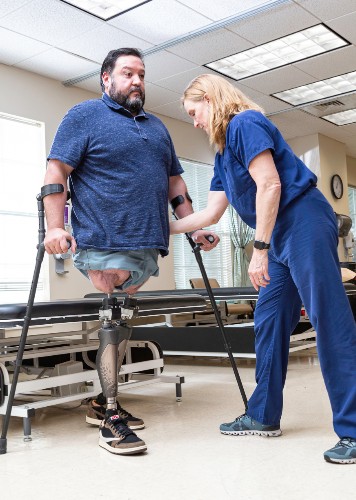 Osseointegration, or direct percutaneous skeletal attachment, directly connects the prosthetic component to the patient’s skeleton, eliminating the need for a socket, which is one of the most challenging parts of fitting a prosthesis, according to Dr. Vanodia, who previously worked as a board-certified prosthetist, fabricating prosthetic limbs. Because the prosthesis is directly attached to the bone, patients also have osseoperception, meaning they can perceive, or “feel,” the surface they’re walking on, something they can’t do with standard prosthetics, he adds.
Although the technology used in socket-based prosthetic limbs has improved significantly in recent years, the socket still presents challenges for patients. “For example, in patients who have lost the lower portion of their leg, the remaining muscle and soft tissue or the residual limb is fitted into a hard carbon fiber shell known as the prosthetic socket,” Dr. Vanodia says. “If the patient experiences weight gain or loss, changes in volume or size of the limb can affect the fit and comfort of the prosthesis.”
As a result, a high percentage of patients with bilateral lower-extremity amputations rely on wheelchairs.1
To date, surgeons affiliated with Memorial Hermann have performed more than 50 of these OI procedures, the majority in patients with single, above-knee limb loss or with transfemoral amputation. Although the benefits of OI are significant for these patients, according to Dr. Vanodia, those who undergo bilateral transfemoral amputations can see an even greater impact with the procedure.
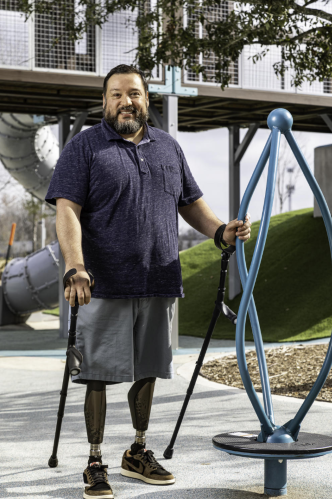
Houston real estate attorney Alex Weatherford, who was in his early 30s when he lost both legs above the knee in a 2014 plane crash, was one patient at TIRR Memorial Hermann who decided to forgo standard socket fit prosthetics—even after months of rehabilitation—and to use a wheelchair instead. “The carbon fiber shells (sockets) that fit over your legs are big and bulky,” Weatherford recalls. “They’re hot on the skin and when you sweat, they lose suction and come off. I tried for a year and a half with the prostheses, but they weren’t for me.” However, after OI received FDA approval in 2021, Weatherford and his care team at TIRR Memorial Hermann decided to give the novel approach a try in April 2021.
For the first month of the training process, Weatherford used short training prostheses that lower the center of gravity to load the bone and muscles in a static position. At this stage, he would stand for 30 minutes on the short prostheses, beginning with 40 pounds of weight and moving up from there. The weight was adjusted with a mechanical patient lift, according to Dr. Vanodia.
After a month of training, Weatherford was able to switch to full-length prosthetics, but with the knee locked to assist with balance and stability. Subsequently, he began training on functional activities, including walking. Gradually, he moved into traditional gait training on level surfaces, before adding stairs, ramps and more higher-level activities.
Now, five years later, Alex Weatherford is living life and is active, particularly with his four children. “It is such an amazing surgery,” he says. “The first time I stood and straightened to my height, it was surreal.”
The rehabilitation protocol used in Weatherford’s case was developed at TIRR Memorial Hermann and is now used in all OI patients at the hospital: It has also been adopted by other centers across the country. In a study evaluating its efficacy, authored by Dr. Vanodia and the OI team, patients underwent an average of 16 rehabilitation sessions over a six-month period and showed significant improvements in Amputee Mobility Predictor (a measure of range of motion and function), Six-Minute Walk Tests and 10-meter fast-walk scores. All patients were walking after OI surgery.2
However, there are potential adverse events associated with OI, including an increased risk for infection. The devices also are not designed for high impact scenarios, as this can lead to bone fracture in the integrated limb. To date, Mr. Weatherford hasn’t experienced any complications.
“Not many hospitals have a comprehensive limb loss program like we do at TIRR Memorial Hermann,” Dr. Vanodia says. “Being able to offer OI surgery and rehabilitation through a continuum of care at Memorial Hermann is significant, particularly given the intense process of surgery and rehab, along with the psychosocial impacts of limb loss. The OI procedure has made such a big difference in the lives of many patients.”
At Memorial Hermann Health System, we are on the forefront of the revolutionary osseointegration procedure. We are one of the only programs in the nation to combine this highly specialized amputee implant surgery with a nationally recognized, long-term rehabilitation program.
Learn More About Osseointegration (OI)
References
- Leijendekkers RA, van Hinte G, Frölke JP, et al. Functional performance and safety of bone-anchored prostheses in persons with a transfemoral or transtibial amputation: a prospective one-year follow-up cohort study. Clin Rehabil. 2019;33(3):450-464.
- 2. Reeves K, Han S, Cao M, et al. A goal-directed rehabilitation protocol for people with transfemoral amputation receiving osseointegration prostheses. PM R. 2025;17(9):1026-1033

Nationally Ranked Rehabilitation
For the 37th consecutive year, TIRR Memorial Hermann is recognized as the best rehabilitation hospital in Texas and No. 4 in the nation according to U.S. News and World Report's "Best Rehabilitation Hospitals" in America.
Learn more about TIRR Memorial Hermann rankings