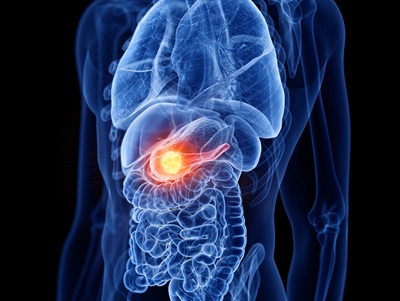
 Enthusiasm and encouragement continue to grow worldwide over a minimally invasive pancreas cancer treatment being tested on patients at Memorial Hermann-Texas Medical Center. Endoscopic ultrasound (EUS) coupled with radio frequency ablation (RFA)—an outpatient procedure—is helping extend the survival of patients with pancreatic ductal adenocarcinoma (PDAC) who are also undergoing standard-of-care chemotherapy, according to preliminary findings of the EUS-RFA PANCARDINAL-1 Trial, underway at Memorial Hermann-TMC.
The principal investigator of the study, Nirav Thosani, MD, is a professor and director of the Center for Interventional Gastroenterology at McGovern Medical School at UTHealth Houston, the Atilla Ertan MD Endowed Chair in Gastroenterology, Hepatology and Nutrition, and an interventional gastroenterologist affiliated with Memorial Hermann-TMC. According to Dr. Thosani, more than 800 of these procedures have been performed at Memorial Hermann-TMC over the past four years.
Endoscopic Ultrasound Radio Frequency Ablation
For the trial, patients who are diagnosed with PDAC begin their treatment with chemotherapy. During the primary course of chemotherapy, they undergo EUS-RFA at Memorial Hermann-TMC. Guided by preprocedural imaging, physicians access targeted tumors of the pancreas using an endoscopic ultrasound probe inserted down the esophagus to the stomach or small intestine. Once the tumor is reached, a needle pierces the wall of the stomach or small intestine to administer the radio frequency ablation. Tumors are subjected to alternating electrical currents which burn—or ablate—the cancer cells, causing the tumors to turn white, indicating their destruction.
To date, it appears the ablation shrinks tumors and stops the spread of cancer in preparation for surgical removal, which is better tolerated when the tumors are smaller. Some 145 patients have enrolled in this trial happening exclusively at Memorial Hermann-TMC.
Dr. Thosani and his colleagues published their findings in the October 2024 edition of GIE Gastrointestinal Endoscopy journal, concluding that a combination of chemotherapy and ablation prior to surgery may provide a “more effective alternative to chemotherapy alone.” These findings have garnered worldwide attention, and Dr. Thosani and his colleagues have presented information about EUS-RFA at national and international conferences. They also have trained physicians from around the globe on how to perform this procedure.
“We’re seeing that survival is improving for these patients, as is their quality of life,” Dr. Thosani said. “As a minimally invasive procedure, it allows patients to return home within hours of the ablation and recovery is quicker. We’ve also seen patients eat more, so nutrition remains consistent with this treatment, which we don’t typically see in traditional treatment approaches.”
Preventing Metastatic Disease
“Pancreatic cancer is the most lethal cancer, with only 12% of diagnosed patients surviving five years after diagnosis,” Dr. Thosani adds. “No new chemotherapy or immunologic advancement has been introduced as we’ve seen with other cancers.”
He attributes the difficulty of treating pancreatic cancer to its ability to resist the body’s immune response, which science has been able to harness and use as a treatment with other types of cancer. Yet research from Memorial Hermann-TMC is further advancing the understanding of pancreatic cancer behavior.
While studying mice models developed more than five years ago by researchers at UTHealth Houston, Dr. Thosani and his colleagues discovered that cellular debris left over after tumors were destroyed by EUS-RFA contains components that circumvent the resistance mechanism of pancreas tumors and jumpstart the body’s immune response. Further studies revealed that when primary tumors were treated, keeping this cellular debris somewhat intact, metastatic tumors were sought out and destroyed by the body’s own immune system. This abscopal effect, Dr. Thosani and his fellow researchers posited, could change the standard treatment for resectable tumors of the pancreas.
From this hypothesis and the evidence obtained through the mice models, the UTHealth Houston research team, led by Dr. Thosani, developed and initiated the second phase of the EUS-RFA PANCARDINAL-1 Trial. This trial will study the feasibility, tolerability and treatment effect of EUS-RFA plus standard-of-care neoadjuvant chemotherapy and whether the abscopal effect created by the cellular debris will aid in the treatment of metastatic disease. Dr. Thosani and UTHealth Houston researchers are also sharing their findings with physicians and other researchers at conferences and forums around the world.
“We have done the highest number of EUS-RFA procedures in the world, so we have a lot of evidence to share,” Dr. Thosani says. “We see applications of EUS-RFA plus chemotherapy treatment for other gastrointestinal cancers, including biliary, stomach and colon following our research.
“Pancreatic cancer is one of the deadliest types of cancer, and most patients lose hope at diagnosis. By leveraging the evidence we have and will collect, we are giving new hope to patients fighting this cancer.”
Sign Up to Connect With Us
Fill out the form below to receive the Memorial Hermann Cancer Newsletter in your inbox.