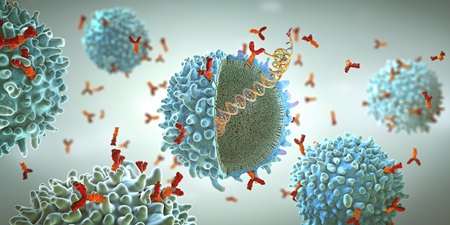
 Patients who have been diagnosed with myeloma, leukemia, lymphoma, melanoma or small cell lung cancer now have an advanced treatment option available to them at Memorial Hermann Cancer Center – Texas Medical Center. Treatment for these types of cancers broadened in 2022 with FDA approval of several types of bispecific T-cell engagers, or BiTEs, and Memorial Hermann Cancer Center – TMC began offering this therapy in 2024.
Sara Taveras Alam, MD, assistant professor of Oncology at McGovern Medical School at UTHealth Houston and an affiliated hematologist/oncologist who oversees treatment at Memorial Hermann Cancer Center – TMC, says that bispecific antibody therapy is a treatment that harnesses the T cells of a patient’s immune system and links them to cancer cells to kill the cancer cells.
“It’s a modality of cancer therapy that we use when a relapse of one of these cancers, following standard-of-care treatment, occurs,” she says. “It has unique toxicities that require expertise to monitor and manage, so we most often administer it in the inpatient setting.”
These toxicities include cytokine release syndrome (CRS) and immune effector cell-associated neurotoxicity syndrome (ICANS).
At Memorial Hermann-TMC, patients who receive infusions of bispecific therapy are carefully watched for up to 72 hours by nurse practitioners and nurses who specialize in oncology. Treatment begins with smaller doses that are incrementally increased over time, and the team monitors patients for fever, low blood pressure and low oxygen, indicative of CRS. The team also evaluates patients for the telltale signs of ICANS, including confusion, difficulty speaking, weakness and paralysis, and administers medications, such as steroids, to stop these reactions.
For patients at low risk for side effects, outpatient injections and infusions are also administered in clinic on the 29th floor of the Memorial Hermann Medical Plaza. These can take from 30 minutes to four hours. Dr. Taveras has worked collaboratively with clinical staff in the Emergency Department and in the ICU as well as with hospitalists to properly respond to and care for patients experiencing any side effects following outpatient treatment. Moreover, Memorial Hermann Cancer Centers are accredited by the American College of Surgeons’ (ACoS) Commission on Cancer (CoC).
Bispecific antibody therapy can be administered regularly—often weekly—to achieve and maintain remission. Studies are underway to determine if patients on certain bispecifics may retain their response with finite treatment durations, rather than indefinitely, to retain the benefits.
Dr. Taveras is the principal investigator of a study beginning in the spring at Memorial Hermann-TMC to determine the most effective treatment schedule for patients with myeloma. Studies are also underway to see if bispecific therapy may be used as a first-line treatment, rather than following several rounds of chemoimmunotherapy.
Regardless of the treatment duration, this treatment has shown promise, with patients achieving and maintaining remission.
“It’s not yet widely available, and we are fortunate to have it available at Memorial Hermann-TMC,” Dr. Taveras says. “We work closely with referring hematologists and oncologists to treat their patients but keep them under their care, which ultimately benefits the patients.”
Recently, Dr. Taveras began treating an individual with relapsed multiple myeloma whose plasma cells were circulating in the patient’s blood. This high-risk case, Dr. Taveras says, was treated with a combination of two bispecific drugs and is showing promising outcomes.
“This therapy has revolutionized the care for patients when there were no options before, and we are excited to offer hope to these patients,” she says.
Sign Up to Connect With Us
Fill out the form below to receive the Memorial Hermann Cancer Newsletter in your inbox.