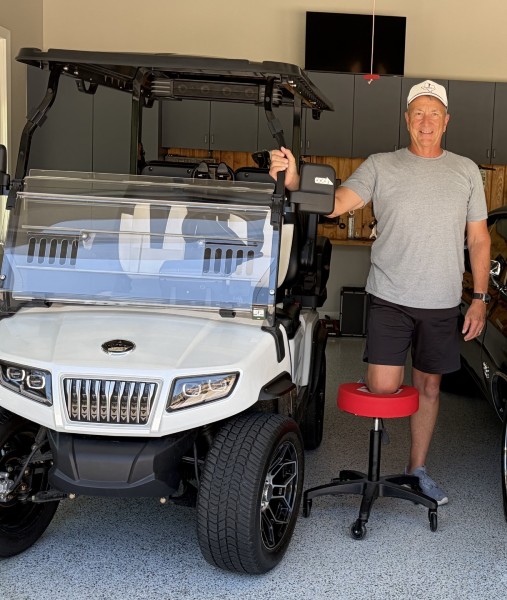
 For years, Mark Reese of Magnolia, Texas, learned to live with pain. The 67-year-old stayed active, played golf several days a week, rebuilt cars, worked out, lifted weights and enjoyed spending time with his wife, Bonnie. He is even lucky enough to be able to spend time with several of his grandchildren who live nearby.
But underneath his active lifestyle was a persistent lower back pain and hip that had followed him for nearly seven years. Like many people with nagging aches and pains, Mark found ways to explain it away. “I got so accustomed to lower back pain,” he said. “I was making up reasons why I had it.” But eventually, the pain became impossible to ignore.
Understanding Lumbar Spinal Stenosis and Chronic Back Pain
In October 2025, Mark was building a shed and spending long days lifting lumber and performing heavy construction work. On the final day, something changed. “I was brought to my knees,” he said.
The pain became so severe that he struggled to walk and often moved around his house on a rolling shop stool. For someone accustomed to constant activity, the physical limitations were frustrating and frightening. “I've got to be busy. I've got to be moving,” Mark said. “From October through December, I was frustrated and scared and couldn't get around the way I was used to. I thought for a short while that was my future.”
An MRI eventually revealed the real problem: degenerative lumbar spinal stenosis. Mark was suffering from a condition in which the spinal canal in the lower back gradually narrows over time, placing pressure on the spinal cord and surrounding nerves. This pressure can lead to pain, numbness, weakness and difficulty walking.
Searching for Answers After Years of Lower Back Pain
Mark met with several specialists and explored different treatment options. Some recommended therapy and spinal injections. Others recommended even more physical therapy. He left all those appointments feeling discouraged. Besides, he had gym equipment at home. He was doing the exercises at home, too. Nothing helped ease his pain.
Over time, Mark’s quality of life was severely impacted. “After talking with multiple surgeons, I walked away feeling rushed and like I was an inconvenience to them. The solutions they offered seemed to accommodate their schedules rather than address my pain. I felt like I was boring them and had slipped into a world of protocol rather than genuine care,” Mark said.
The experience left him wondering if anyone truly understood what he was going through. Then he met Keith Kerr, MD, a neurosurgeon and spine specialist at Memorial Hermann’s Mischer Neuroscience Associates–Cypress, located on the campus of Memorial Hermann Cypress Hospital.
For the first time, Mark felt he had found a physician who truly listened and understood what he was going through. He left the appointment feeling hopeful and relieved.
The Appointment That Changed Everything
Mark was able to get an appointment quickly. From the moment he arrived, he and Bonnie were impressed. “I absolutely loved the staff,” he said. “From the reception people to the staff in the back.”
During the appointment, Mark handed Dr. Kerr the MRI report and imaging studies. What happened next immediately caught his attention. “Dr. Kerr wasn't looking at the report,” Mark recalled. “He was looking at the MRI. He was telling me what he saw, why it happened and was answering questions I didn't even know to ask. Every other doctor was reading reports and relying on the radiologists’ interpretations to make their diagnoses. Dr. Kerr was telling me what he thought.”
"When evaluating patients with lumbar spinal stenosis, it's important to look beyond the radiology report and correlate the imaging findings with the patient's symptoms and physical examination," Dr. Kerr said. "The goal is to identify exactly which nerves are being compressed and develop a treatment plan that addresses the source of the pain while helping patients return to the activities that matter most to them."
Drawing on his experience in treating complex spine conditions, Dr. Kerr reviewed the imaging himself and took time to explain the source of Mark's symptoms and the treatment options available to him.
Unlike previous appointments, Mark felt fully engaged in the conversation. “I never sensed a bit of that arrogance with Dr. Kerr,” he said. “Not for a second.”
At one point, Mark asked a question that would ultimately make the decision easy. “I asked him, ‘Would you do this procedure on your father?’ Dr. Kerr didn't hesitate. He said, ‘absolutely.’ I knew I found my neurosurgeon.”
A Personalized Approach to Spinal Stenosis Treatment
Dr. Kerr recommended a lumbar laminectomy, a surgical procedure designed to relieve pressure on compressed spinal nerves. A laminectomy involves removing a small portion of bone from the spine to create additional space around the nerves. In Mark's case, the procedure focused on the L3-L4 levels of his lower back, where the narrowing was causing significant symptoms.
As part of Memorial Hermann’s comprehensive spine program, Dr. Kerr developed a treatment plan tailored to Mark's condition, symptoms and goals. He carefully explained the procedure and answered every question.
Mark and Bonnie told him they wanted to think about whether they wanted to move forward with the surgery. “But it didn’t take long. We got in the car after the appointment and looked at each other,” Mark said. “We agreed that Dr. Kerr was the one we wanted to perform my spinal surgery and we called the office and scheduled it for late December.”
“From the first appointment to recovery, I felt like I mattered,” Mark said.
Recovering After Lumbar Laminectomy Surgery
On Dec. 29, 2025, Mark underwent surgery performed by Dr. Kerr at Memorial Hermann Cypress. Even after the procedure, the physician's attentiveness stood out. Dr. Kerr personally stopped by to check on him and share the good news. “He said the surgery went great,” Mark recalled.
Three weeks after the surgery, most of the stiffness and pain from the procedure was gone. “I realized it was the first time in seven years I wasn’t hurting,” Mark added.
Following surgery, Mark completed physical therapy through the Memorial Hermann Sports Medicine & Rehabilitation The Woodlands (Sterling Ridge). His rehabilitation program helped him safely rebuild strength, mobility and confidence while supporting his return to the activities he enjoyed most.
Working with physical therapist Megan L. played an important role in that recovery. “She was very knowledgeable and she was absolutely a champ,” Mark said. “She knew golf and she understood where I needed to get to.”
Most importantly, she helped him understand the purpose behind every exercise. “No one looks forward to physical therapy, but she made me understand why I had to do what she was saying,” said Mark.
Back to Golf, Grandkids and Living an Active Life
Today, Mark says he feels better than he did before surgery. “Here I am five or six months later. I'm better than 100%,” he said.
He has returned to working out three times a week, golfing, working on cars and enjoying an active lifestyle without pain. Though, he jokes, “Dr. Kerr and Megan were not able to lower my handicap!”
One moment stands out above all others. “It was humbling and embarrassing when I hurt my back. I spent my entire life working to be healthy and strong for those you love and then—BAM!—I couldn’t pick up my grandkids or walk with them on Halloween,” Mark said. “After physical therapy, when I was able to pick them up and I knew I was back.”