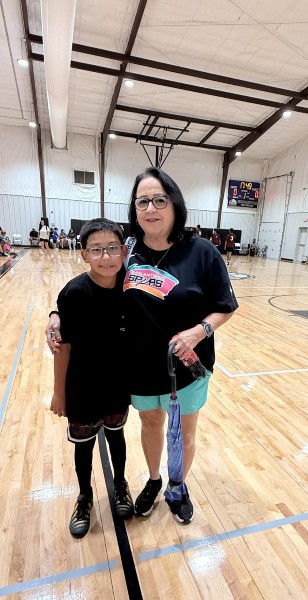
 Beverly Gutierrez had always enjoyed an active life. Whether she was shopping with friends, spending time at the beach or cheering on her grandson at sporting events, she filled her days with the people and activities she enjoyed.
Then lower back pain began changing everything.
What started as occasional discomfort gradually became more persistent, until the pain made even simple daily activities difficult. Eventually, Beverly found herself sitting in the car at her grandson’s baseball games because the walk from the parking lot to the field felt impossible.
After more than two years of intensifying pain and unsuccessful attempts to find lasting relief, Beverly was referred to Krish Vigneswaran, MD, a neurosurgeon at Memorial Hermann’s Mischer Neuroscience Associates-Southwest, located on the campus of Memorial Hermann Southwest Hospital. After evaluating her condition, he recommended spine surgery, a decision that would help her reclaim the full, busy life she worried she had lost.
When Chronic Back Pain Changes Everyday Life
Beverly’s pain did not begin with a major injury or accident. Instead, it started as morning discomfort in her lower back before spreading into her left leg. She described the sensation as feeling like needles shooting down her leg.
Back pain can range from a dull ache to a severe, shooting or stabbing sensation, and it can interfere with the ability to move, sleep, work and participate in everyday activities. While many cases improve with rest, medication or physical therapy, it may be time to see a spine specialist when pain lasts more than two weeks, travels into the legs or causes numbness, tingling or weakness.
Like many people experiencing chronic back pain, Beverly initially hoped the symptoms would improve with conservative treatment. Before coming to Memorial Hermann Southwest, she had worked with other care providers and pursued a variety of treatments, including pain management, injections, a back brace, physical therapy and a minimally invasive procedure intended to relieve pressure in her lower back.
Nothing provided the relief she needed. As the months passed, Beverly found herself making more adjustments to her daily routine. Sitting through dinner at a restaurant became difficult. Trips to the grocery store became exhausting. Activities she once enjoyed were slowly replaced by staying home.
The emotional toll became just as significant as the physical pain. “Honestly, I was feeling pretty miserable,” Beverly said. “I was getting depressed, and I cried a lot. I really thought that was just going to be my life.”
As attending her grandson’s games became harder, Beverly felt guilty when family members had to stay behind with her. She did not want to depend on others in that way.
Then a trusted friend encouraged her to seek another opinion. The friend had experienced similar symptoms and undergone successful spine surgery with Dr. Vigneswaran. After hearing his story and learning that others had experienced positive outcomes as well, Beverly decided to schedule a consultation.
When Beverly first connected with Dr. Vigneswaran’s team at Mischer Neuroscience Associates-Southwest, she said the experience immediately felt different. She recalls the staff being welcoming and organized, helping guide the referral process and answering her follow-up questions with kindness.
After reviewing Beverly’s MRI scans and diagnostic imaging, Dr. Vigneswaran identified degenerative changes and nerve compression in her lumbar spine. These changes were placing pressure on nearby nerves, causing the constant lower back pain and radiating leg pain that had steadily worsened over time.
Beverly remembers Dr. Vigneswaran using imaging, medical models and examples of the surgical instruments to explain exactly what was happening in her spine and how surgery could help. “He was so understanding and reassuring,” Beverly said. “He explained everything to me and answered my questions. He looked at me and said, ‘We can fix this.’”
For the first time in years, Beverly felt a sense of optimism about what came next.
Finding Relief Through Minimally Invasive Lumbar Fusion Surgery
At Memorial Hermann Southwest, spine care brings together pain management, neurosurgery and spine surgeons to help patients find the right path based on their symptoms, imaging, goals and quality of life.
For Beverly, Dr. Vigneswaran recommended a minimally invasive robotic-guided L3-L4 spinal fusion and revision. This is a procedure designed to stabilize part of the lower spine while decompressing nerve roots and eliminating abnormal motion. “During a lumbar fusion, we use minimally invasive techniques coupled with robotics and navigation to decompress and stabilize the spine with minimal soft tissue disruption,” said Dr. Vigneswaran. “The goal is to reduce motion at the painful spinal segment, relieve pressure on affected nerves and create a more stable foundation for movement.”
The goal was not simply to treat Beverly’s pain temporarily, but to address the underlying structural problem contributing to her symptoms. After years of limited relief from other treatments, surgery offered a way to reduce the nerve irritation that had made walking, sitting and everyday movement so difficult.
On Aug. 25, 2025, Beverly underwent surgery at Memorial Hermann Southwest in the state-of-the-art robotic spine suite. The surgery addressed the problem area in her lower spine and included removing previously placed hardware that had not provided meaningful relief.
When Beverly woke up from surgery, she knew she would still need time to heal. She still felt soreness from surgery, but almost immediately, she could tell the pain that had dominated her life for years was no longer the same.
Beverly quickly became eager to get moving and told her daughter she was ready to walk. By the following morning, she was walking the halls, sitting comfortably in a chair and telling her care team she felt ready to go home. Originally expecting to spend several days in the hospital, Beverly was discharged the day after surgery.
For the first time in years, Beverly felt the weight of uncertainty begin to lift. “I just knew my life was going to be better,” she said. “After everything I’d been through, I finally felt like there was hope again. I felt like I was getting my life back.”
Reclaiming Her Independence
Within days of returning home, Beverly was moving more comfortably and regaining the independence she had feared she might lose.
Her daughter helped during the early stages of recovery, but Beverly was able to resume many daily activities faster than she expected. As she continued recovering over the following weeks, physical therapy became an important part of the healing process.
Because Beverly lives in Victoria, Dr. Vigneswaran’s team helped coordinate physical therapy closer to home, with updates shared back to the Mischer Neuroscience Associates-Southwest team during her recovery. She attended therapy twice a week, focusing on rebuilding strength, improving flexibility and restoring mobility. Sessions included stretching exercises, resistance-band training, balance work and stationary biking.
Throughout recovery, Dr. Vigneswaran continued to monitor her progress through follow-up appointments and imaging studies, to see that her healing remained on track.
Today, Beverly’s life looks very different than it did before surgery. She is back attending her grandson’s baseball, soccer and basketball games. She can sit in the bleachers without pain. She can shop for hours again. She can spend time with friends and make plans without worrying whether her back will allow her to participate. Above all, she feels like herself again.
Beverly says it is difficult to fully express how grateful she feels. “Within a week, I was up and moving and going places again,” she said. “I was out of bed, out of my room, back at work and back with my family. It felt like a miracle.”
For others struggling with chronic back pain, Beverly hopes her story serves as a reminder not to give up searching for answers. “Don’t lose hope,” she said. “Find a doctor who listens to you, answers your questions and helps you understand what’s going on. I thought I was going to have to live with that pain forever, and I was wrong. I’m so grateful for everyone at Mischer Neuroscience Associates.”
Today, instead of watching life pass by from the sidelines, Beverly is back to enjoying the active life she has always loved.
Learn more about spine disorders and back pain care at Memorial Hermann »