 When Addison Suhr's left shoulder started hurting during the summer of 2025, it seemed like the kind of ache many active teenagers experience. The pain came and went, making it easy to dismiss at first.
But over the next couple of months, the discomfort spread. Numbness crept into two fingers on her left hand, followed by weakness that left Addison barely able to use her left arm. Eventually, the energetic teenager from Fargo, North Dakota, who loved horseback riding, ice skating, shooting and fishing, began struggling with everyday activities.
Her parents, Caitlin and Codie, felt in their hearts something far more serious was happening. They took Addison, now 14, to local physicians who suggested months of physical therapy. When physical therapy didn't help and Addison's symptoms continued to worsen, her doctors ordered extensive testing to determine what was causing the pain, numbness and weakness.
The test results revealed that Addison was suffering from an unusual condition in children: pediatric thoracic outlet syndrome.
After months of searching for answers, countless appointments and an exhaustive nationwide search for the right surgeon, Addison and her family traveled more than 1,500 miles to Children's Memorial Hermann Hospital in Houston.
There, they found Natalie Drucker, MD, a pediatric surgeon and co-director of the Pediatric Vascular Surgery Program who treats patients with thoracic outlet syndrome, along with a pediatric care team equipped to manage Addison’s complex condition, from surgery through recovery.
What Is Pediatric Thoracic Outlet Syndrome?
Thoracic outlet syndrome occurs when nerves or blood vessels traveling between the neck and shoulder become compressed. This narrow passageway, called the thoracic outlet, carries nerves, arteries and veins that supply the arm and hand with blood. When this type of compression occurs, different structures of the body can be affected.
Neurogenic thoracic outlet syndrome puts pressure on the nerves. Venous thoracic outlet syndrome affects the vein that returns blood from the arm to the heart. Arterial thoracic outlet syndrome compresses the arteries that deliver oxygen-rich blood to the arm. Some patients experience more than one form of thoracic outlet syndrome.
Addison had all three.
Extensive testing showed that blood flow through her left arm became severely restricted during certain arm positions. Blood also pooled in the veins instead of circulating normally. Because Addison also has a genetic clotting disorder, her doctors were concerned that the impaired circulation could increase her risk for additional complications and loss of function.
Caitlin, a registered nurse, wasted no time researching the next steps. “We saw it progressing over time,” she said. “Once I knew her vascular system was involved, the situation was dire, and I wasn’t willing to wait and risk Addison’s arm.”
Finding a Pediatric Thoracic Outlet Syndrome Surgeon
Caitlin approached the search for a pediatric surgeon experienced in treating thoracic outlet syndrome the way she approaches nursing. Rather than simply searching online, she studied published medical research and identified physicians actively investigating the condition.
She contacted nearly 40 physicians she had worked with throughout her nursing career, hoping someone could point her toward an expert. She identified neurologists, thoracic surgeons and vascular surgeons with experience performing surgery for thoracic outlet syndrome, but Caitlin was looking for something more specific.
"I wanted someone who had dedicated a significant part of their career to this condition," Caitlyn said. "Many surgeons can technically perform the operation, but I wanted someone who regularly cares for patients with thoracic outlet syndrome, especially children."
That distinction proved important.
Several specialists Caitlin found treated thoracic outlet syndrome in adults but did not have the pediatric experience she was seeking. Her search ultimately led her to Natalie Drucker, MD, a pediatric surgeon affiliated with Children's Memorial Hermann Hospital in Houston.
An introduction through one of Caitlin's physician colleagues led to a phone call on March 7, 2026. "That phone call changed the trajectory of the path we were on," Caitlin said. "Dr. Drucker didn't make promises. She wanted to review every image and every test herself. But after talking with her, I knew this incredible physician was the one for my daughter."
Within days, Dr. Drucker and her team had gathered Addison’s records and reviewed her imaging and test results. Despite the 1,500 miles separating the family in North Dakota from the care team in Houston, they were able to begin evaluating Addison’s case and developing a treatment plan before the family made the long trip to Texas.
Caitlin said she never felt the need for an in-person consultation before traveling to Houston. Speaking with Dr. Drucker by phone gave her the reassurance she needed. "For the first time," Caitlin said, "we had answers and a plan."
Traveling to Houston for Pediatric Thoracic Outlet Syndrome Surgery
Rather than fly, the family drove to Houston. Since Addison is home-schooled, they made a geography lesson out of the journey. In all, they took 26 hours to make the road trip.
Finally, on March 30, they met Dr. Drucker in person. "She was warm and comforting, but very direct," Caitlin said. "She explained exactly what surgery could accomplish, but she was also completely honest about the risks."
Just as importantly, Dr. Drucker made Addison an active participant in every conversation. "She never ignored Addison because she was a child," Caitlin said. "She made sure Addison understood every step of the surgery and what recovery would look like."
That approach impressed both mother and daughter. "I know a lot of surgeons can seem intimidating," Caitlin added. "Dr. Drucker is straightforward, but incredibly kind. I think being a mother herself makes a difference."
Complex Thoracic Outlet Syndrome Surgery Relieves Compression
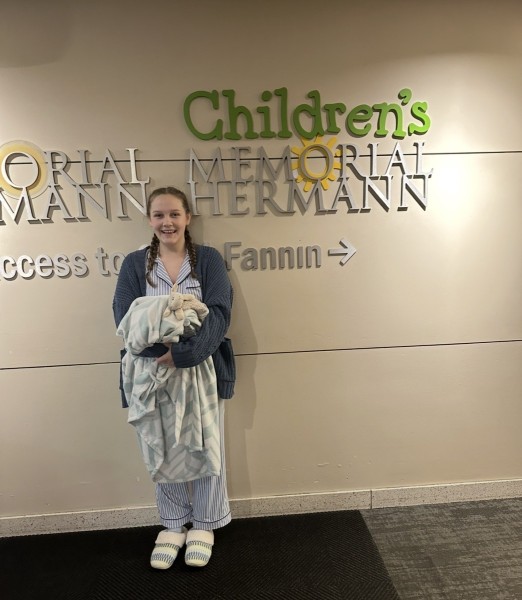 On March 31, Addison underwent surgery at Children's Memorial Hermann Hospital with the affiliated Pediatric Vascular Surgery team, to relieve the severe compression affecting the nerves, arteries and veins serving her left arm.
During the procedure, Dr. Drucker found that the compression was even more extensive than the preoperative imaging had suggested. “Addison had significant inflammatory changes around her nerves and vessels between her neck and her chest,” said Dr. Drucker. “She had also developed thick muscles compressing the space between her collarbone and her first rib. We were able to divide the inflammatory tissue to relieve the compression and free the nerves.”
The team for Addison’s case consisted of S. Keisin Wang, MD, a vascular surgeon affiliated with Children’s Memorial Hermann Hospital; Justin McCarty, DO, an affiliated plastic and nerve surgeon at Children’s Memorial Hermann Hospital; and Dr. Drucker. The multidisciplinary approach brought together the different surgical specialties needed for these relatively uncommon procedures.
The rapid progression of Addison’s symptoms made timely treatment especially important. By then, she was experiencing tingling and pain even without moving her arm in certain ways. Treating the compression as soon as possible was critical to reducing the risk of long-term nerve damage.
“Her family had consulted multiple physicians who were either unable or uncomfortable performing the procedure on a child before they found our hospital,” said Dr. Drucker. “It’s a story we’ve heard from other families as well, and it’s one of the reasons we are committed to improving vascular surgery care for children and have assembled a dedicated multidisciplinary team.”
That team includes affiliated pediatric surgeons, vascular surgeons, plastic surgeons, cardiac surgeons and interventional radiologists who work together to evaluate and treat children with complex vascular conditions. Formed within the last two years, the collaboration brings multiple specialties together to provide comprehensive care focused on the needs of the whole child.
Over the next week, Addison's care team carefully managed her pain while treating two temporary postoperative complications. One was a pleural effusion, a buildup of fluid around the lungs that can sometimes occur after chest surgery. The second was Horner syndrome, which can occur when nearby nerves are affected and may cause changes to the eyelid, pupil or sweating on one side of the face. Addison's symptoms resolved.
Throughout every challenge, Caitlin said the care never wavered. "There is no way to put into words how grateful we are for Dr. Drucker and her team at Children’s Memorial Hermann Hospital.
"And the nurses were fabulous," she said. "No one assumed that because she was a child she wouldn't understand. Everyone spoke directly to Addison. Everything was explained to her, and they always asked whether she had questions."
The family also appreciated the small moments that made a long hospital stay feel less overwhelming. Addison looked forward to visits from the therapy dog. And, because the family remained in Houston over Easter, hospital staff organized cookie decorating activities that helped brighten Addison’s time in recovery.
Even after eight days in the hospital, Caitlin said they never doubted they had come to the right place. "Was traveling to Children’s Memorial Hermann Hospital from North Dakota worth it? One thousand percent."
For Caitlin, seeing her daughter on the road to recovery made every bit of research and every mile driven worthwhile.
"There sure is no place like home," she said. "But Children's Memorial Hermann Hospital was incredible. When we were there, we were treated like family."
Learn more about pediatric vascular surgery at Children’s Memorial Hermann Hospital »
The Children’s Heart Institute is a collaboration between the affiliated physicians at McGovern Medical School at UTHealth Houston and Children’s Memorial Hermann Hospital. Typically, patients are seen on an outpatient basis at a UT Physicians clinic with all inpatient procedures performed at Children’s Memorial Hermann Hospital.