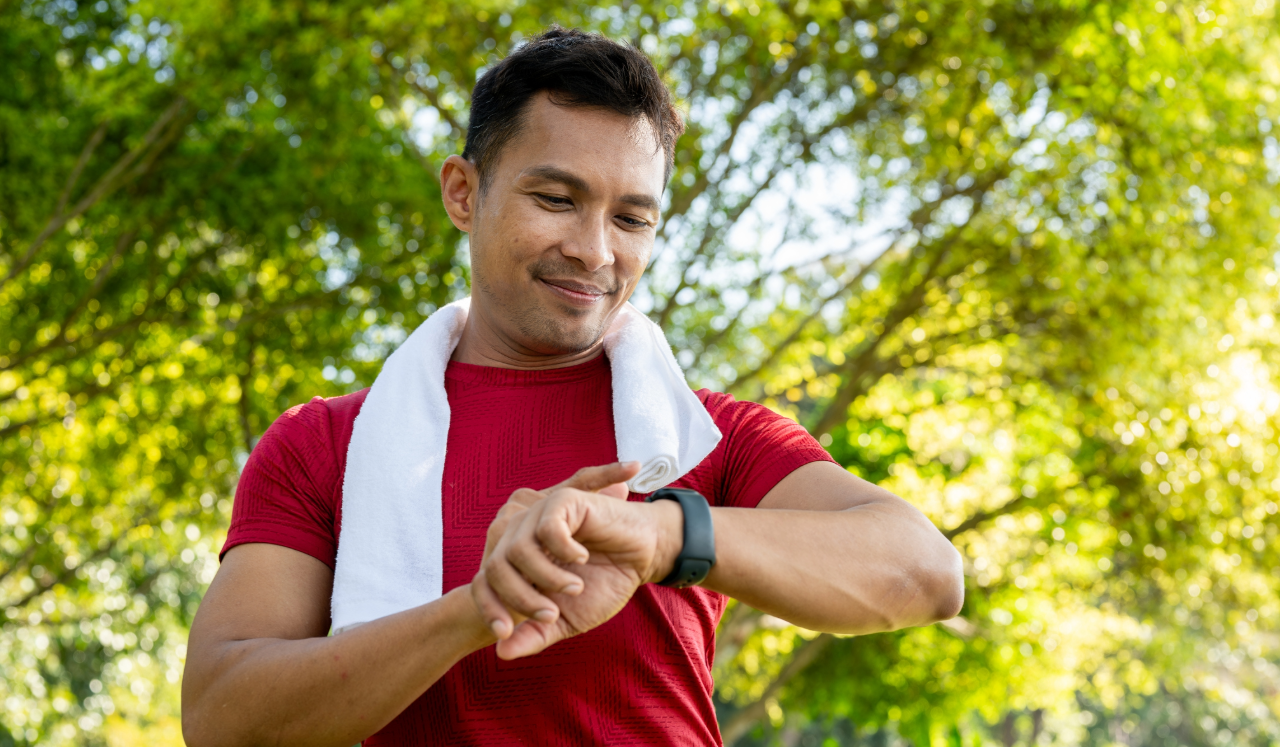
You've been going to the gym consistently, making healthier food choices and putting in the work. But how do you know if all your work is actually making a difference?
Christopher Slocum, director of Advanced Performance and Rehabilitation with Athlete Training and Health, located in Memorial Hermann Sports Parks, says tracking your fitness journey can help you recognize improvements, stay motivated and make adjustments that bring you closer to your goals. And while numbers can be useful, they're only part of the picture.
Why It Is Important to Track Your Fitness Progress
Whether you're trying to lose weight, build muscle or improve your endurance, it's difficult to see how far you've come without knowing where you started. The key, according to Slocum, is to consistently track your progress.
Consider someone who begins strength training. During their first few weeks, they may lift the same weights simply because those are their usual exercises and repetitions. Without recording their workouts, however, they may continue repeating the same routine without realizing they're ready for a greater challenge.
It’s easy to lose track of time, but tracking can help you see exactly what you’ve been doing for how long. “When you track your weights and reps, you get a visual journey of progress that can help you know when it’s time to move up the next time around,” Slocum says.
In strength and conditioning, that process is known as progressive overload. By gradually increasing the demands placed on your body, such as by lifting heavier weights, completing more repetitions or improving your running pace, you are continuing to challenge yourself as your fitness improves. The weight you used in a bench press when you first started will not challenge you the same way three months into your journey.
Furthermore, tracking provides a record of accomplishments that might otherwise go unnoticed. Maybe you started by lifting 20 pounds and can now comfortably lift 35. Or perhaps running a mile once felt impossible, but today you can complete it without stopping. Those improvements tend to happen gradually, making your advancements difficult to appreciate. Looking back at your starting point can reveal just how much you've accomplished.
That sense of progress can be especially valuable when your motivation begins to fade. Rather than focusing only on how far you have left to go, tracking provides tangible evidence that your efforts are indeed making a difference and reaching small milestones gives you a reason to celebrate.
What You Should Track on Your Fitness Journey
There's no single measurement that captures every aspect of fitness. What you track should depend on your goals, the activities you enjoy and the improvements you're hoping to make. Slocum recommends looking beyond body weight stats to several other areas of your health.
Strength Training
Record the exercises you complete, the amount of weight you lift and the number of sets and repetitions you perform. Progress might mean lifting a heavier weight, completing more repetitions with the same weight or gradually increasing the difficulty of an exercise.
For example, someone who begins by performing 10 repetitions with a 20-pound dumbbell may eventually be able to complete 12 repetitions at the same weight or move up to a heavier dumbbell and maintain the 10 repetitions. Both represent improvement.
Cardiovascular Fitness
If you enjoy walking, running, cycling or other endurance activities, track your distance, duration or pace. You might work toward running a mile faster, walking farther without stopping or completing the same route with less difficulty.
Slocum says progress doesn't always require increasing distance. “Someone who isn't comfortable running five miles, for example, can continue improving by focusing on their one-mile time,” he advises.
Sleep and Recovery
Exercise is only part of improving fitness. Your body also needs opportunities to recover. “Sleep is such a massive, important part of developing muscle, losing weight, improving energy and just being productive,” Slocum says.
Consider tracking how many hours you sleep, how rested you feel when you wake up and whether you're experiencing unusual fatigue or muscle soreness. Wearable devices can also provide information about sleep, recovery and resting heart rate.
Slocum says all the data you gather can help guide your workouts. If you've slept poorly or feel particularly fatigued, it may be better to reduce your workout intensity rather than push yourself to your limits. The goal is to recognize when your body is ready for a challenge and when it needs additional recovery.
How You Feel
Not every improvement can be measured with a stopwatch or recorded in pounds. Pay attention to changes in your energy, mood, confidence and ability to complete everyday activities. Perhaps you can climb a flight of stairs without getting winded, your clothes fit more comfortably, or you feel stronger carrying groceries.
These improvements deserve recognition, even when the scale hasn't moved.
Nutrition
For people interested in buckling down on their nutrition, Slocum recommends starting with a registered dietitian or other qualified nutrition professional. They can help you establish your baseline and develop an individualized plan to help you reach your goals based on activity level and nutritional needs and preferences.
For others, Slocum says a simpler approach may be more practical than monitoring every calorie you consume. Below are a few easy steps to help you improve your nutrition:
- Create a food journal where you write down everything you eat. While this is less intense than tracking every calorie, it does provide a record of what you’re consuming and the very act of writing down the foods you eat does provide accountability.
- Focus on eating a variety of foods (fruits, vegetables, proteins) and “fill your plate with color.”
- Pay attention to portion sizes and eat until satisfied instead of overly full.
- Consume an adequate amount of protein (the current recommendations are 1.2 and 1.6 grams of protein per kilogram of body weight) to support muscle development and satiety if your goal is to build muscle while losing weight.
Rather than turning every meal into a mathematical exercise, focus on developing healthy eating habits you can maintain over time. Tailoring your nutrition to your health goals can often feel like squeezing all the joy from mealtime, so it may be helpful to address one meal at a time rather than trying to go all in at once.
How to Track Your Fitness Progress
Once you've decided what to measure, the next step is deciding on a way to record it. Fortunately, tracking doesn't have to be complicated or expensive. Slocum says the best method is one that feels natural and is easy enough to use consistently.
- Pen and paper. A simple notebook can be an effective workout log. Record your exercises, weights and repetitions, then review previous entries to identify opportunities for improvement. Despite having access to sophisticated technology, Slocum still prefers this approach for his own workouts.
- Your phone or computer. A basic notes app or spreadsheet can accomplish the same thing without requiring a separate fitness platform. You can create a running list of workouts, organize your progress by date or use a spreadsheet to compare your results over time.
- Fitness apps and AI tools. Dedicated fitness apps can organize workouts, track personal records and visualize progress. AI chatbots can also summarize workout logs and compare previous performances, helping you identify improvements and trends over time.
“Find a way to track your progress that's simple, easy and doesn't take a lot of effort,” Slocum suggests. “The important thing isn't how sophisticated your tracking method is. It's whether you'll actually use it.”
A Note About Tracking Your Weight
For many people, the scale is the most familiar way to measure progress. But Slocum cautions against giving too much importance to any single weigh-in. Body weight naturally fluctuates throughout the day based on factors like when you last ate, hydration and other normal changes. Weighing yourself every morning can set you up for discouragement if you’re seeing small increases here and there; this perpetual focus on body weight can distract you from the progress you're making.
If you choose to track your weight, Slocum recommends using the same scale on a flat, hard surface to help ensure consistent readings. Also consider these practices:
- Weigh yourself at approximately the same time of day, preferably in the morning.
- Consider weighing yourself once a week rather than every day if frequent measurements become discouraging or you find yourself obsessing over every fluctuation.
- Record your results and focus on the overall trend across several weeks or months rather than individual fluctuations. Consider creating a graph that you update at the beginning of each month. This might be something you look forward to plotting, and it also gives you a visual of progress.
It's also important to remember that body weight doesn't tell the whole story. Someone who is strength training may gain muscle while losing body fat, meaning their weight might not change as much as expected. In those situations, body composition measurements can provide additional insight into changes in fat and lean mass.
But you don't necessarily need specialized testing to recognize improvement. Better-fitting clothes, increased strength, improved endurance and higher energy levels can all indicate that your efforts are having an impact.
Your Health Is an Investment in Your Future
Tracking your fitness journey is about more than reaching a particular weight, running a faster mile or lifting a heavier dumbbell. Those milestones can be meaningful, but the greater goal is building a healthier body that supports you throughout your life. Slocum describes this philosophy with a familiar saying: Health is wealth.
Maintaining your health can help you continue enjoying the things that matter most as you get older. Whether that's traveling after retirement, keeping up with your children or grandchildren or simply maintaining the strength and independence needed to manage everyday activities, the work you put in today can benefit you for years to come.
And just as financial investments generally need time to grow, improvements in strength and overall health often develop gradually through consistent effort. Tracking helps you recognize your progress, make informed adjustments and stay encouraged when the results aren't immediately visible. Slocum emphasizes that lasting improvement doesn't require getting everything right from the beginning. “You don't have to be perfect, but consistency is key,” he says.

