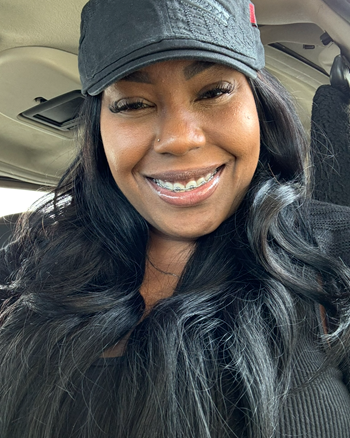
 Tarneshia Lewis wanted to have surgery to reduce the size of her breasts. The pre-operative requirements for the surgery included a mammogram, and as an associate for Blue Cross and Blue Shield of North Carolina, she knew she would have to follow these requirements. Even though the 49-year-old Manvel resident had noticed a lump in her left armpit several months before the mammogram, she discounted it as a swollen lymph node like something she had experienced as a child.
“The report came back that I had four masses and the recommendation was to have them biopsied,” she recalls. “January 30, 2026, changed my life forever. I had to sit with myself for 30 minutes or so, when they told me I had breast cancer.”
Then, she got to work and called her aunt, who worked in oncology and led her to Iman Doostan, MD, PhD, a medical oncologist from McGovern Medical School at UTHealth Houston, who is affiliated with Memorial Hermann Cancer Center – Texas Medical Center. After a one-hour consult with Dr. Doostan, and Tarek Zaghloul, MD, PhD, assistant professor of breast surgical oncology at UTHealth Houston and a surgeon, specializing in breast disease, also affiliated with Memorial Hermann-TMC, she had a preliminary treatment plan.
“They scheduled me for all kinds of testing,” Lewis says. “I felt like a pin cushion.”
Based on her test results, which indicated she had HER2+ breast cancer—an aggressive form of the disease—the doctors recommended six cycles of chemotherapy and targeted therapy to stop cancer cell growth, followed by surgery and then radiation.
“We placed her port at the end of February, and her treatment began on March 6,” Dr. Zaghloul says. A port is placed by a surgeon and allows easy access for infusions of medications to be given into the body’s blood vessels.
“The chemotherapy completely shrunk the lump under my arm within the first five days,” Lewis remembers. “I couldn’t feel it at all!”
At a follow-up appointment with Dr. Doostan, he cautioned that even though the tumor had shrunk to a size she couldn’t feel, it was still present on imaging. Moreover, the imaging revealed she had two enlarged lymph nodes. One lymph node, especially, concerned specialists at a biweekly conference, or Tumor Board, held jointly between Memorial Hermann and UTHealth Houston to discuss cancer cases and personalized treatment plans for patients based on international guidelines, most recent clinical studies and advances in breast cancer.
“Ms. Lewis had a supraclavicular lymph node, above her collarbone, that looked suspicious for cancer,” Dr. Zaghloul notes. “We, during Tumor Board, collectively discussed her case and recommended a biopsy of that lymph node.”
Turns out, the biopsy showed the lymph node contained cancer cells, elevating Lewis’ cancer to stage III.
Lewis continued her chemotherapy infusions and tolerated the treatment well.
 After completing six rounds of chemotherapy and following a three- to four-week recovery period, she underwent breast surgery at Memorial Hermann-TMC on July 20. On the advice of Dr. Zaghloul, Dr. Doostan and the specialists from the Tumor Board, Lewis opted for a segmental, or partial, mastectomy. Commonly referred to in the public as a “lumpectomy,” this type of surgery, Dr. Zaghloul says, removes the cancerous portions of the breast along with a surrounding area of tissue known as “margins” to see whether there’s evidence of cancer outside of the tumor. Dr. Zaghloul also collaborated with Lewis’ plastic surgeon to produce an even and esthetic result, reducing the size of her right breast and lifting both breasts evenly.
“I wanted to have a double mastectomy,” Lewis notes, “but Dr. Zaghloul’s confidence that this treatment would work, in my case, made me confident in the decision to only remove what was necessary.”
“I explained to Ms. Lewis, as I do with some patients, that a complete removal of the breast wouldn’t change her outcome, her survival or prevent any spread,” Dr. Zaghloul says. “The HER2+ nature of her cancer, her initial response to treatment and the fact that she didn’t have a genetic mutation were all factors in recommending the segmental mastectomy.”
Pathology reports after the surgery indicated that the tumors were all dead. Lewis was considered “pCR,” which Dr. Zaghloul explains indicates a pathologic complete response to the chemotherapy—the treatment had worked.
Following her surgery, Lewis began her radiation treatment, consisting of 30 weekday treatments, which will minimize the risk that cancer cells will come back in her breast and lymph nodes. She will also receive targeted therapy of monoclonal antibodies for a year to help prevent cancer cells from growing by feeding off of HER2 proteins in the body. She will resume regular yearly mammograms six months after her final radiation treatment and be examined by Dr. Zaghloul every three months for the first two years, then every six months up to five years, and then every year until ten years after her surgery. She will also have regular blood tests, known as ctDNA, which can detect cancer cells in the blood up to six months before tumors show up on imaging studies.
Lewis credits the care she received from Dr. Zaghloul and the team at Memorial Hermann for giving her confidence in her treatment. “Dr. Z was really sure about my treatment plan working, and that made me feel secure about it.”
She wants other women facing a similar diagnosis to know that breast cancer isn’t necessarily a death sentence. “I don’t want them to be scared, because it’s doable,” she says. “Find out everything you need to know about your diagnosis and find doctors you can trust.”