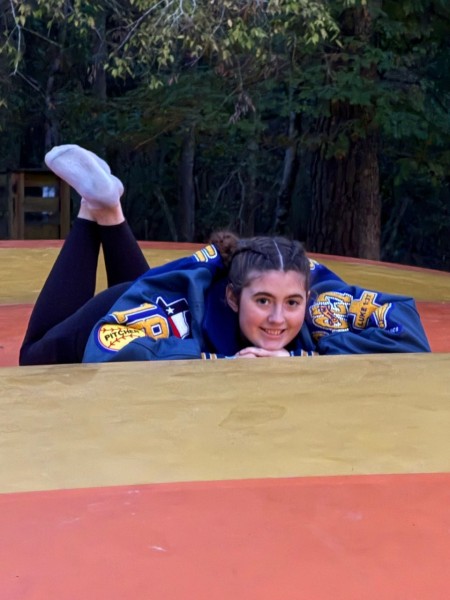
 On Sept. 6, 2025, Myra Fennell was a healthy, active teenager, focused on softball, school, volunteering and spending time with friends.
Then, the next day, she was awakened out of a deep sleep by excruciating pain. “There was no warning for this at all. She went to bed and 30 minutes later she started screaming bloody murder,” recalled Myra’s mother, Jenna. “I ran upstairs as fast as I could and I found her crying in pain, but we had no clue what was happening.”
The next morning, the family set out on what would become a long and frustrating journey to find answers.
In Search of Answers
A visit to the emergency room the morning after she woke up screaming led to what can only be described as a “wild goose chase” from doctor to doctor. The pain wrapped around Myra’s ribs and back. At first, physicians suspected gastrointestinal, or digestive, problems. Over the following months, Myra saw multiple specialists, including gastroenterologists, pulmonologists, orthopedic specialists, pain management physicians and physical therapists.
“I had all these tests and the doctors said there was nothing wrong with me,” Myra said. “It was just so crazy. I was taking all kinds of pain medications, and they really didn’t help at all. I felt like the doctors weren’t really listening to me, or maybe they just weren’t believing me. But none of them were able to help me.”
Meanwhile, for the next two months, Myra said the severe pain in her ribs and back was at a “9 or 10 on a pain scale of 10.”
Despite multiple scans, treatments, nerve blocks and pain medications, the family still had no answers. By January, Myra’s condition had worsened so significantly that she was struggling to walk and had to stop attending school in person. “Each doctor had their own thoughts on what it could be, but then the tests would come back and show everything was normal,” Jenna said.
Everything changed when Myra was referred to Dr. Keith Kerr.
A neurosurgeon and spine specialist with Memorial Hermann’s Mischer Neuroscience Associates – Cypress, located on the campus of Memorial Hermann Cypress Hospital, Dr. Kerr determined she was suffering from a spinal arachnoid web, a rare spinal condition.
His suspicion was based on subtle imaging findings that can easily be overlooked due to the rarity of the condition. “Because spinal arachnoid webs are uncommon, patients often go through an extensive evaluation before receiving a diagnosis,” said Dr. Kerr. “Careful review of the imaging studies and correlation with the patient’s symptoms are critical. Once we identified the source of Myra’s spinal cord compression, we were able to develop a surgical plan to relieve the pressure on her spinal cord and address the underlying cause of her symptoms.”
Arachnoid webs are bands of scar-like tissue that form around the spinal cord. The spinal cord is the bundle of nerves that carries signals between the brain and body. These webs can place pressure on the spinal cord and interfere with movement, sensation and other body functions.
Neuroscience Team Diagnoses Rare Spinal Arachnoid Web
At Myra’s first appointment, Dr. Kerr carefully explained what he was seeing on the imaging studies.
“When he was going through the MRI with us, he was showing us the narrowing of the spinal canal and how the spinal cord was being pushed forward,” Jenna said. “That explained why she was in so much pain and why her legs felt weak and heavy.”
The spinal canal is the protective space that surrounds the spinal cord. When that space narrows, it can place dangerous pressure on the nerves.
“It was definitely the reason for the excruciating pain,” Jenna said.
For the first time in months, Myra felt heard.
“Dr. Kerr is the best,” Myra said. “He walked into my first appointment with so much confidence. I immediately felt like he already knew what was wrong with me. After the appointment, I told my mom, ‘I know he is going to fix me. I have no doubt. We found the right doctor finally.’”
Myra and Jenna both say Dr. Kerr’s communication and compassion made an enormous difference during an overwhelming time. “He explained everything to us in a way we could understand,” Myra said. “He walked us through his thought process and what he wanted to do. Honestly, it made me feel sane and listened to. He heard what I was saying.”
Jenna was equally impressed with the entire care team. “Everyone in Dr. Kerr’s office is kind and knowledgeable,” she said. “They answered every single question we had. I’ve been so impressed with the entire group from top to bottom.”
To confirm the diagnosis, Dr. Kerr recommended a myelogram, a specialized imaging test that uses contrast dye to better visualize the spinal cord and nerves. Because the procedure can be painful, Myra underwent it under full anesthesia on Dec. 29, 2025. On Jan. 8, 2026, Dr. Kerr confirmed it was Arachnoid webs and said she would need surgery.
“I actually smiled when he said I needed surgery,” Myra recalled. “I was just so happy we finally had an answer and that it would take away my pain. I was so excited at the possibility of getting my life back.”
Less than two weeks later, on Jan. 20, 2026, Myra had spinal surgery at Memorial Hermann Katy Hospital.
He performed surgery to relieve pressure on Myra’s spinal cord. The procedure eliminated her debilitating pain and restored her quality of life.
Memorial Hermann’s neuroscience program provides advanced care for complex brain, spine and nervous system disorders, including rare conditions that often require highly specialized diagnostic expertise and treatment.
Now, Myra, a pitcher, is looking forward to her senior year in high school and has already started touring colleges. She hopes to become a pediatric orthopedic physician, inspired in part by the care she received at Memorial Hermann and the difference one physician can make in a patient's life.
“He changed my life for sure,” Myra said.
Despite the seriousness of spinal surgery, Myra said she never felt afraid. “She relied heavily on her faith,” Jenna said. “When she found Dr. Kerr, she knew there was no reason to be worried. She said she had 100% faith in Dr. Kerr and that God had her.”
Myra spent five days recovering in the hospital. She was up and moving by the second day and steadily improved each day afterward. Within a week of returning home, she no longer needed a walker. “After the surgery, I didn’t have any rib pain, back pain, headaches or leg heaviness at all,” Myra said.
Dr. Kerr’s support continued throughout her recovery.
“Dr. Kerr’s bedside manner was unbelievable,” Jenna said. “He was there almost every day and if he wasn’t there, his physician assistants were checking on Myra. He is amazing and I can’t say enough good things about him. He was an answer to all of our prayers.”
Life after Spinal Surgery
Myra missed about nine weeks of school while recovering but was so committed to keeping her grades up that she worked closely with her teachers and a homebound instructor. She made straight A’s and was inducted into the National Honor Society.
Even during recovery, she remained deeply connected to softball and attended every game after spring break. Now, she is looking forward to pitching and hitting lessons with hopes of playing again next softball season.
The experience also shaped her future goals. A member of the Class of 2027, Myra volunteers with children through Girl Scouts, Vacation Bible School and youth ministry programs. She now hopes to pursue a career in medicine as a pediatric orthopedic physician. “I want kids to be seen and heard like I was by Dr. Kerr,” she said. “I want to be that doctor for kids.”