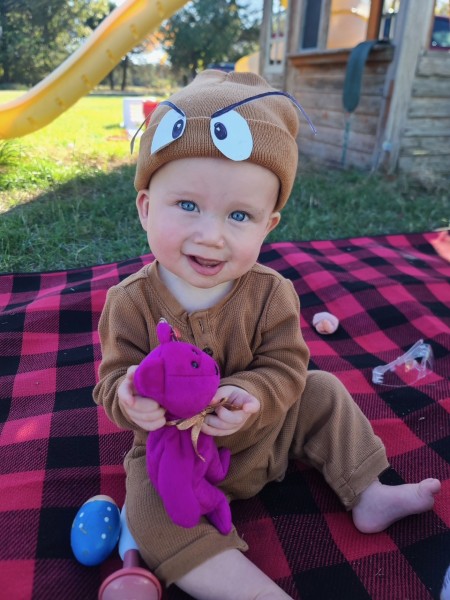
 When Melanie Allen went in for her routine 20-week anatomy scan with her husband, Andy, she expected to see their healthy baby boy growing strong. Instead, the Greenville, Texas couple learned that their son, Link, had congenital diaphragmatic hernia (CDH), a rare, life-threatening condition that affects roughly one in 2,500 babies each year.
CDH occurs when the diaphragm, the muscle separating the chest and abdomen, does not form correctly. A hole or missing section allows abdominal organs (such as the stomach, intestines and liver) to migrate into the chest cavity, compressing the developing heart and lungs and preventing normal lung growth.
CDH severity is graded from A to D, with D being the most severe. Imaging confirmed that Link’s CDH was at the most critical end of the spectrum. Doctors estimated that his lungs would be only about one-third of the expected size at birth.
“He was missing the entire left side of his diaphragm,” Andy said. “His stomach and abdominal organs all shifted into his chest and pushed his heart and lungs to the right. Even with surgery, we were told by our local team that his chances of surviving were fifty-fifty.”
The diagnosis was devastating. The Allens suddenly faced complex, time-sensitive decisions about Link’s care. “It was almost too much to process,” Andy said. “But we had each other and our son, Loki, and we were willing to do whatever it took to help Link survive.”
Choosing the Best Place for CDH Care
Their local physicians explained that although several hospitals in Dallas were closer to home, none matched the CDH specialized care approach available at Children’s Memorial Hermann Hospital in Houston. Link would likely need extracorporeal membrane oxygenation (ECMO) after birth and the Allens were told they needed a center with vast experience caring for newborns requiring ECMO in the setting of severe CDH.
ECMO is a form of life support that functions like an external heart-lung machine. Blood is circulated out of the body, oxygenated, cleared of carbon dioxide and returned, giving critically ill babies time to heal. “We were told that ECMO is not a cure all but a critical support mechanism in CDH,” said Andy. “We knew that if Link needed ECMO, we had to be at a hospital with the most experience caring for babies with CDH.”
Their doctor referred them to Matthew Harting, MD, associate professor of Pediatric Surgery at McGovern Medical School at UTHealth Houston and an affiliated pediatric surgeon at Children’s Memorial Hermann Hospital. The hospital, internationally recognized for its CDH Program, has treated babies with CDH for more than 40 years. The CDH program takes a multidisciplinary approach for both prenatal and postnatal care and treatment, involving affiliated UTHealth Houston physicians for prenatal care at The Fetal Center at Children’s Memorial Hermann Hospital, which is widely regarded as a national leader in fetal diagnosis, intervention and comprehensive care for infants with congenital anomalies or genetic abnormalities. For care and treatment after delivery and beyond, the pediatric surgery team provides specialized CDH postnatal surgery, ECMO management and follow-up care.
Andy submitted an online request for more information. “I couldn’t believe it but later that same day, Dr. Harting called my personal cell phone,” he said. “I thought I’d hear from an admin about scheduling. Instead, Dr. Harting took the time to call me back. That was a huge green flag for us. We knew we had to go meet him.”
Soon, the couple made the five-hour drive to Houston. Over two full days, they met with Maternal-Fetal Medicine specialists, toured The Fetal Center and walked through every possible care scenario. “They gave us the information we needed,” Andy said. “We knew that Link had to be born in Houston.”
Considering FETO: A Rare Option for Severe CDH
During their visit, the Allens learned about a procedure they had never expected to consider: FETO, or fetoscopic endoluminal tracheal occlusion. This highly specialized intervention, offered at only a handful of U.S. centers, is performed at The Fetal Center at Children’s Memorial Hermann Hospital. The couple met with Anthony Johnson, DO, professor of Obstetrics, Gynecology and Reproductive Sciences at UTHealth Houston and co-director of The Fetal Center, whose extensive experience with fetoscopic and needle-guided in utero procedures made him the ideal surgeon to perform the FETO.
Here’s how FETO works: At about 28 weeks of pregnancy, a tiny fetoscope is inserted into the mom’s uterus and a small balloon is placed inside the baby’s trachea to prevent fluid from escaping. This allows lung fluid to accumulate, stimulating accelerated lung growth. The balloon is later removed so the baby can breathe after delivery. In Link’s case, the balloon was removed at 33 and 5/7 weeks using an ultrasound-guided percutaneous needle puncture. Because the balloon temporarily blocks the trachea, it must be removed before delivery and before the umbilical cord is cut—otherwise the baby would be unable to breathe and could die from asphyxiation. For this reason, once the balloon is placed, patients must remain within 30 minutes of Children’s Memorial Hermann Hospital throughout the remainder of the pregnancy, a requirement that ultimately prompted the Allens to relocate from Dallas.
With the complexity of Link’s condition, Dr. Johnson explained that performing FETO would be especially challenging because he would likely require ECMO shortly after birth. “When a baby’s lungs are this underdeveloped, we anticipate significant respiratory compromise immediately after delivery,” Dr. Johnson said. “That level of severity means we have to plan carefully, because both the procedure and the timing must align perfectly to give the baby the best chance at survival.”
Opting for the FETO procedure would require the Allens to uproot their lives for the remainder of Melanie’s pregnancy—and likely much longer—because they already knew Link would spend an unknown number of weeks in Children’s Memorial Hermann Hospital’s Level IV neonatal intensive care unit (NICU). The timing also added more pressure: Melanie was already 24 weeks pregnant and FETO must be performed around 28 weeks.
Moving forward meant she would need to relocate to Houston for the remainder of her pregnancy, with constant monitoring and an on-call chaperone, all while trying to run her business and care for their energetic 2-year-old son, Loki. Along with the risks of FETO, the family initially declined the procedure. “We weren’t comfortable with it at first,” explained Andy. “The procedure is relatively new and the doctors explained all the risks. They were very real risks. It just didn’t feel right for our family.”
Then, during the five-hour drive home to Greenville, the weight of the information began to sink in. “It was a lot to process,” Andy admitted. “The doctors did a great job explaining everything and answering our questions. We kept thinking about how Dr. Harting told us FETO, despite its risks, could increase Link’s chance of survival. That was enough to make us decide to go for it.”
On Nov. 29, 2023, Melanie underwent the 90-minute surgery while awake. She was discharged the next day but remained in Houston. She and her son, Loki, settled into temporary housing in Houston while Andy rotated between work in Greenville and family time in Houston.
Welcome to the World, Link: From Delivery to ECMO to Life-Saving Surgery
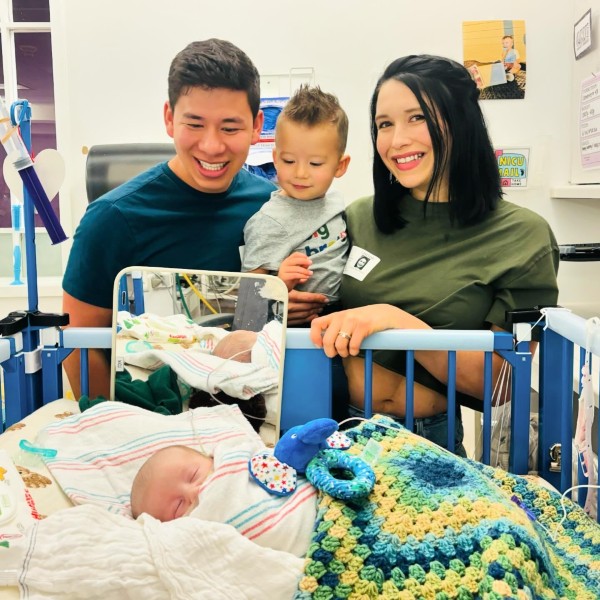 At 36 weeks, Melanie’s water broke unexpectedly. Link was delivered, a special breathing tube was placed and he was stabilized. Within 36 hours, his team determined his lungs were too underdeveloped and he needed ECMO. “We knew there was a 50% chance he’d need ECMO right away,” Andy said. “He was big enough at 6 pounds, 7 ounces for the procedure, which helped make it possible.”
Link spent 11 days on ECMO in the NICU at Children’s Memorial Hermann Hospital. One of the advantages of receiving care here was the surgical team’s ability to operate on babies while still supported by ECMO, a highly specialized capability that only certain centers possess.
“This approach allows us to relieve pressure on the lungs much earlier, giving them the space they need to expand, improve blood flow and function optimally,” Dr. Harting said. “In Link’s case, that early relief was critical. During surgery, we moved his stomach and intestines out of the chest and reconstructed the missing portion of his diaphragm. It was a complex operation, but each step was essential to give his lungs the best chance to grow and recover.”
63 Days in the NICU and a Lifetime Ahead
Link spent 63 days in the NICU. He required a gastric feeding tube, oxygen support and later a helmet to help correct head shape after prolonged time lying flat. Occupational and speech therapists helped him learn to swallow and build motor skills. At 13 months, Link had fully caught up.
Now nearly 2 years old, he runs, climbs, laughs and plays nonstop with big brother Loki. His favorite toys are dinosaurs, and his favorite show is “Blippy,” which he gleefully calls “Bippy.” “Around our house, Link is a wrecking ball,” Andy said, laughing.
Gratitude That Lasts
The Allens say they felt reassured at every step that choosing Children’s Memorial Hermann Hospital was the right decision.
“We kept thinking, ‘We made the right choice,’” Andy said. “Nothing surprised the team. They knew exactly what to do at every moment. I knew there was a chance Link might not make it, but in my heart, I never thought he would die. We knew he was going to be OK because of the team at Children’s Memorial Hermann Hospital.”
Learn more about congenital diaphragmatic hernia care at Children’s Memorial Hermann Hospital »