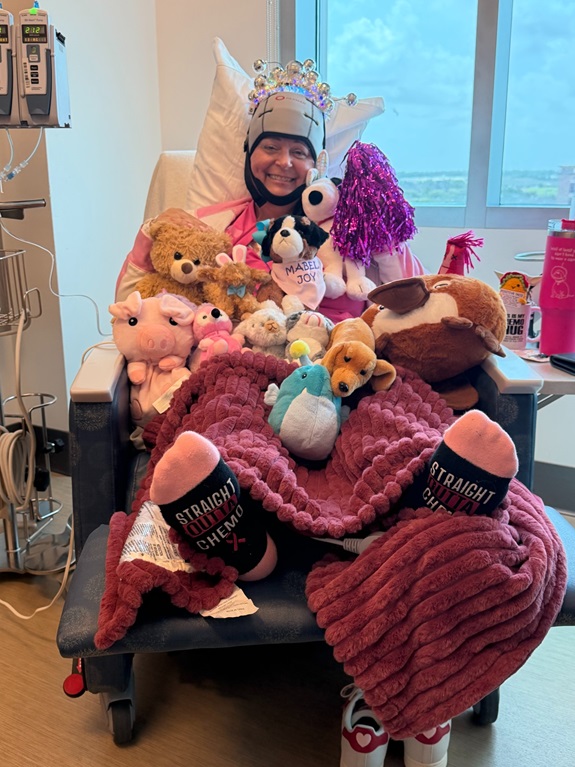
 Laurie Bass is no stranger to the impact that breast cancer has on people’s lives. The 54-year-old events industry professional from Friendswood vaguely remembers her paternal grandmother passing away from the disease when Bass was only 5 years old. Later in her life, Bass watched the effects the disease had on her maternal grandmother who faced two separate occurrences of the disease in her 50s and again in her 70s. “Because of my strong family history, I began having regular mammograms at 35,” she recalls.
Her family history also meant that Bass qualified for genetic testing to determine her risk of developing breast cancer herself. Bass’ genetic test, surprisingly, revealed no genetic mutation that would predispose her to breast cancer. Still, she knew annual mammograms would help her stay ahead of the disease if it did develop.
Last October, Bass had her annual mammogram and didn’t think much about it afterward. When she received a phone call that the mammogram revealed a suspicious area that needed to be biopsied, she followed the radiologist’s recommendation, still feeling confident about her lack of symptoms and the absence of a telltale lump in her breast.
“When I got the call after the biopsy letting me know that it was breast cancer, I remember I had a work call right after,” she recalls. “I was so disconnected during that call that when I hung up, I had to call my boss and tell him what I had heard just before joining that meeting. There was so much to digest.”
As she sought the next steps, Bass was referred to and met with Tarek Zaghloul, MD, assistant professor of breast surgical oncology at McGovern Medical School at UTHealth Houston and a surgeon specializing in breast disease and affiliated with Memorial Hermann. “Laurie had invasive ductal carcinoma (IDC), and it was determined, through testing, to be triple-negative breast cancer,” Dr. Zaghoul says. “This type of breast cancer doesn’t have receptors for treatments that target estrogen, progesterone or HER2 protein. This type tends to grow and spread faster than other types of invasive breast cancer.”
Imaging of Bass’ breast indicated that the tumor was less than 2 centimeters in size. Dr. Zaghloul and her oncologist told Bass that she could have surgery to remove the tumor first, but that she would need to have chemotherapy because of the triple-negative aspect and invasive attributes of her tumor. Radiation therapy would also be needed, the doctors told her, as part of the breast-conserving therapy she was leaning toward.
She also factored in the recovery time for a mastectomy and reconstruction versus that of the breast-sparing lumpectomy. “The three of us had honest conversations, and because they said I had the same chance of a recurrence with a lumpectomy as with a mastectomy, I opted for the lumpectomy, followed by chemotherapy and then radiation,” Bass says.
According to Dr. Zaghloul, Memorial Hermann and UTHealth Houston hold multidisciplinary conferences, referred to as Tumor Boards, every two weeks. They discuss personalized treatment plans for patients based on international guidelines, most recent clinical studies and advances in breast cancer. Bass’ case was discussed at one of these meetings, with the specialists agreeing on her treatment plan.
Bass underwent surgery at Memorial Hermann-Texas Medical Center on January 21, 2026. Dr. Zaghloul removed a 1.8 cm tumor with surrounding tissue that serves as a safety margin to detect any potential spread of the cancer outside of the primary tumor. He also removed a few lymph nodes, called the sentinel lymph nodes, which are most likely to show the potential of cancer spreading to other parts of the body. Following the TNM Staging System, referring to the size of the tumor (T), whether lymph nodes (N) show evidence of cancer and whether it has spread, or metastasized (M) to other parts of the body, Bass’ cancer was classified as stage I. The surrounding tissue, or margins, were also negative for any spread. The size and stage of the cancer meant that Bass’ original treatment plan would move forward.
Now that she had the tumor removed, she would undergo four cycles of chemotherapy over the next three months, followed by radiation treatments five days a week for four weeks. “During my treatment, I used humor and sarcasm to get me through,” Bass says.
She donned whimsical headbands, such as bunny ears around Easter, disco balls and the symbol for radioactivity during her radiation treatments. She also handed out gift bags with inspirational sayings, wooden “pocket hugs,” bookmarks, bracelets with pink ribbons, pens and small mirrors to other patients in the waiting room to help them smile and encourage them. “Cancer’s never going to take my ability to laugh or to fight,” she says. “I wanted to help others smile, too.”
While Dr. Zaghloul points to a well-documented 92% survival rate over five years for patients with Bass’ type of cancer following the recommended treatment, Bass knows that her type of cancer also has a high recurrence rate in the first year. She knows she faces more frequent surveillance and scans to detect any developing abnormalities.
At the same time, she’s looking forward to traveling with her boyfriend upon completion of her radiation treatments and plans to volunteer to help cancer patients. She also has compiled a list of local and national resources that offer discounted or free services to people undergoing cancer treatment that she shares with everyone she encounters who may benefit from these resources.
“Cancer is unpredictable,” she says. “Every cancer is different, everyone’s journey is different, and you have to fight it differently. But you have to keep fighting! I am a poster child for early detection. Now that I’m in this community, I can’t imagine not being in it.”