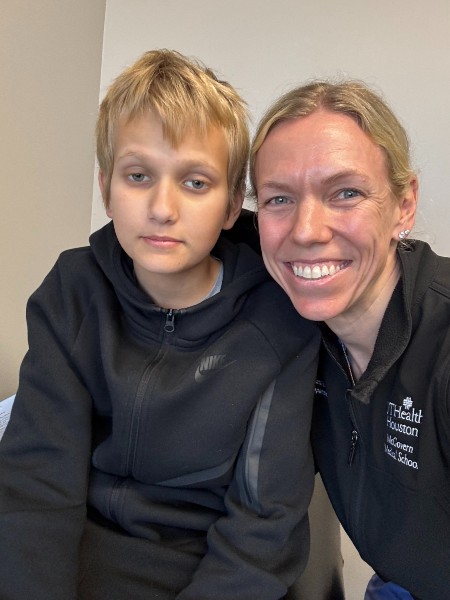
 On Oct. 24, 2024, 12-year-old Joseph Calvin stepped outside for a walk near his home in Port Alto, Texas. It was early evening and a routine moment in an otherwise normal day.
While walking on the grass near the sidewalk, Joseph was suddenly struck by a truck in his neighborhood, fewer than 200 yards from his home. The woman who was driving said the sun was in her eyes when she swerved and struck him.
At the time of the crash, a group of first responders happened to be nearby for a scheduled dinner. When the emergency call came through, they recognized the street name and realized the incident was happening just outside their location. They stepped out immediately and began providing care within minutes.
Joseph’s parents were not aware of the accident at first. They only realized something was wrong when they saw Joseph surrounded by paramedics near their home. “From the moment it happened, he had hands on him,” his father, Stanley Calvin, said. “If it wasn’t for the responders being there, he may not have made it.”
Joseph remained conscious as paramedics stabilized him. Due to the severity of his injuries, he was transported by Memorial Hermann Life Flight® to Children’s Memorial Hermann Hospital in the Texas Medical Center.
“When it happened, we didn’t know what the outcome was going to be,” said his mother, Marla Calvin. “Everything moved very fast.”
Emergency Care and Rapid Response
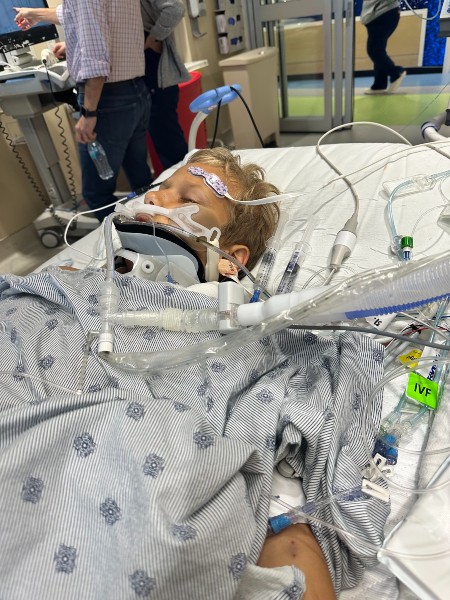
Joseph arrived with extensive traumatic injuries, including a torn inferior vena cava, the body’s main vein that carries blood back to the heart. He also suffered multiple organ injuries, a broken femur and clavicle, and required significant blood transfusions.
Joseph’s treatment was supported by the Pediatric Vascular Surgery Program at Children’s Memorial Hermann Hospital, where rare and complex vascular injuries are treated within a fully pediatric, multidisciplinary environment. His care required close collaboration among trauma surgery, pediatric vascular surgery, critical care, orthopedics, nephrology and interventional specialists.
Dr. Natalie Drucker, MD, assistant professor of Pediatric Surgery at McGovern Medical School at UTHealth Houston and pediatric vascular surgeon affiliated with Children’s Memorial Hermann Hospital, performed the vascular repair together with S. Keisin Wang, MD, assistant professor of Vascular and Endovascular Surgery at UTHealth Houston and vascular surgeon affiliated with Memorial Hermann-Texas Medical Center, along with the affiliated, multidisciplinary team. The team reconstructed Joseph’s inferior vena cava using a specialized membrane derived from a cow heart, a complex and time sensitive procedure.
“Dr. Drucker and the team had to completely reconstruct his main vein,” Marla said. “It was hard to hear, but we trusted them.”
“In cases of severe vascular trauma, timing and coordination are everything,” said Dr. Drucker. “Our goal is not only to repair the injury, but to restore durable blood flow in a way that supports a child’s growth and long-term health. That requires close collaboration across specialties and constant monitoring as the child recovers.”
This team-based approach allowed Joseph’s care team to continually assess circulation, organ function and recovery progress, adjusting his treatment plan as his condition evolved, all within a pediatric hospital environment designed for children with complex injuries.
Keeping Hope Alive and Spirits Up
Joseph remained in a medically induced coma for two and a half weeks as teams monitored his circulation, organ function and overall stability. During that time, Joseph’s family found small ways to stay connected to him. He has five siblings, and early in his hospital stay, they decided to make posters for his room. “For me as a mom, I knew I had to keep his spirits up because he couldn’t,” Marla said. “So, we told his siblings we had to make posters.”
The signs lined the walls of his pediatric intensive care unit (PICU) room, offering encouragement and reminders of home. Nurses and staff saw them every day. “They loved the posters,” Marla said. “The nurses, the respiratory team, everyone wanted to know how he was doing. They helped us get through it.”
That same attention carried over into every part of Joseph’s care, especially as his team closely monitored his circulation and recovery. “Anytime something didn’t look right, they checked it,” Marla said. “They were constantly watching his blood flow and his color. They didn’t wait.”
Stanley agreed. “I’ve been in hospitals from here to New York and Seattle. I’ve never seen teamwork like that. Never.”
Nurses and specialists became familiar faces. ICU nurse Elaine often referred to Joseph as “J Money,” a small gesture that stayed with the family.
“She told us, ‘He’s mine while he’s in here,’” Stanley recalled. “That’s the kind of care Children’s Memorial Hermann Hospital gives.”
As Joseph stabilized, his recovery progressed more quickly than expected much to his parents relief. Doctors initially anticipated a hospital stay of up to nine months. Instead, after just a few weeks, he was moved out of the ICU and into a regular hospital room.
“They told us to prepare for a long stay,” Stanley said. “So, seeing him move out of the ICU that soon was something we didn’t expect.”
“We were taking things day by day at that point,” Marla added.
Joseph’s Road to Recovery
When Joseph was ready to be taken off the ventilator, the room filled with members of the care team. “Everyone was there. They brought in about 35 people,” Stanley said. “I remember wondering why everyone was in the room. Then he [Joseph] pulled the tube out, and everyone started clapping, like their team had just won the World Series!”
Joseph was discharged on Nov. 21, less than one month after the accident. “He came home in a wheelchair, and they told us it would be a while before he’d walk again,” Stanley said. “However, he’s not much for being told he can’t do something.”
At home, Joseph began physical therapy. In one of his first appointments, Joseph noticed a walker in the corner of the room and kept asking if he could try it.
“He kept asking, then he finally said, ‘Ma’am, I hate to be a bother, but I really want to try the walker,’” Stanley said. “He climbed into it and took off down the hallway. The therapist had to chase him!”
Over the next several weeks, Joseph progressed from the walker to crutches. About a month and a half later, he was walking without assistance. By April 2025, just six months after the accident, he was walking independently, albeit with a slight limp.
“He had a full femur break, lost organs and was on dialysis,” Stanley said. “From October to April, he was walking again. That still surprises me.”
Joseph continues to regain strength and sensation in his foot. While he still experiences slight numbness, doctors expect continued improvement. “He didn’t tear the nerves, he stretched them,” Stanley said. “They told us it could take nine months to a year, and he’s already about 95% there.”
Continuity of Care
Today, Joseph, at 13 years old, is back on the basketball court and focused on rebuilding endurance. He has returned to school, is preparing to start high school and is looking ahead to basketball and soccer.
 “He’s processing it all himself,” Marla said. “He’s the one who feels everything, but he takes care of himself and does what his doctors tell him to do.”
The family continues follow-up care with Dr. Drucker and remains in close contact with the team.
“She checked on him in the hospital and after we came home,” Marla said. “Anything that concerned us also mattered to her. If I had a question, she was right there. Even after we left the hospital, she checked in on us. I checked in with her. You don’t find doctors like that.”
As Joseph recovered, Dr. Drucker continued to monitor his circulation closely. When Marla noticed changes in his foot months later, she reached out directly. Dr. Drucker reviewed photos, talked through what to watch for and helped guide next steps, including a follow-up angioplasty to support blood flow.
“She walked me through whether things should look the way they did,” Marla said. “She always made sure his blood flow was good.”
For Stanley, the experience went beyond individual moments of care. “The care and dedication they put in, you only hear about that stuff in movies.”
The family also remembers the ICU nurses, respiratory therapists and specialists across trauma, pediatric vascular surgery, critical care and dialysis who were involved in Joseph’s care. “They checked on every organ in his body while he was in a coma,” Marla said. “The nurses, the respiratory team, everyone. They cared so much, and they checked in on us all day.”
Marla said the consistency mattered just as much as the medical specialized care. “We didn’t know what the outcome was going to be, but they were with us every step of the way. I’m just so grateful we were there. I wouldn’t have wanted anyone else working on my son.”
Learn more about Pediatric Vascular Surgery at Children’s Memorial Hermann »
Contact Us
To contact Children's Memorial Hermann Hospital, please fill out the form below.
If you are experiencing a medical emergency, call 911 or go to the nearest emergency room.
If you or someone you know needs support from the Suicide and Crisis Lifeline, call or text 988.