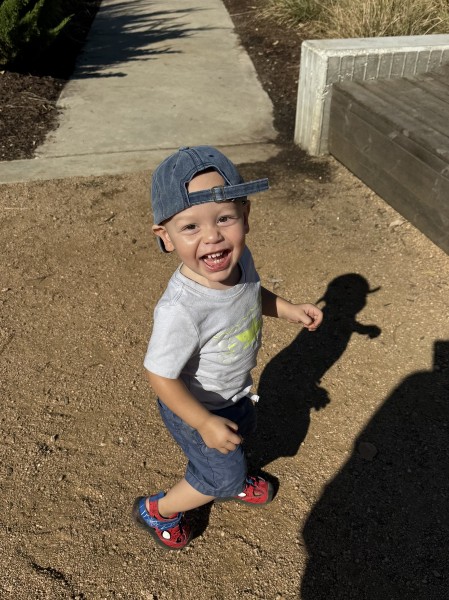
 Jacob Edgington entered the world as healthy and happy as a baby could be. In the months that followed his May 2024 birth, he ate heartily, slept well and hit his milestones right on time.
But at around eight months, his mom saw something that set off alarm bells: intermittent pink urine. "I work in the medical field, so I knew that wasn't normal," said Karen Edgington, a Houston physician's assistant in addition to Jacob's mom.
She brought Jacob to her pediatrician, who suspected the pink urine was probably due to the medication Jacob had been given for a respiratory infection the previous month. After a urinalysis came back negative, the pink urine persisted.
Edgington's instincts told her to push for more testing. When the pediatrician said she wasn't comfortable ordering an ultrasound, Edgington sought an outside specialist.
An Unusual Symptom Leads to Answers
The specialist, a UTHealth Houston nephrologist, ordered new tests. Jacob’s labs initially looked fine, but then his uric acid levels spiked. An ultrasound revealed what no parent wants to hear: he had a mass near his bladder.
It turned out Jacob had neuroblastoma, a rare cancer that develops in the sympathetic nervous system of babies and young children. Although the survival rate is good, aggressive cases can be fatal if not treated promptly.
Within days, Jacob was admitted to Children’s Memorial Hermann Hospital.
A Multidisciplinary Team Takes on a Rare Neuroblastoma
Jacob's case was rare. A palpable mass in the belly is the usual initial presentation, not blood in the urine, which can have many causes. Sub-specialists at UTHealth Houston determined a neuroblastoma had originated in Jacob's bladder and grown into his abdomen.
“Once we actually established it was neuroblastoma, we didn’t lift our foot from the gas pedal the entire time,” said Carly Rosemore, MD, an oncologist affiliated with Children’s Memorial Hermann Hospital and Jacob’s physician.
Because Jacob was under 18 months, doctors hoped the tumor might regress on its own, a common occurrence in many infants. For two months, he showed no symptoms. He was eating, growing and playing like any baby.
But in August, blood in his urine returned. The development meant it was time for chemotherapy. Jacob endured two cycles. The first went smoothly. The second left him nauseated and eating little more than applesauce and graham crackers.
But Jacob took it in stride. "We'd start chemo at about 9 in the morning and finish at about 7 at night, infusion after infusion, but as long as I sat there with him and I was calm, he was calm," said Edgington.
The tumor shrank only modestly. Surgery was the next step.
Surgery — and a Remarkable Recovery
On Halloween Eve, the Children's Memorial Hermann surgical team prepared for a six‑hour operation.
Surgeons Jason Au, MD, a pediatric urologist, and Danielle Hsu, MD, a pediatric surgeon, both affiliated with Children’s Memorial Hermann Hospital, found the tumor completely encapsulated and dumbbell-shaped, with one portion inside the bladder and the other outside. Dr. Rosemore said their expertise, compassion and dedication were a pivotal part of Jacob’s treatment.
The two surgeons removed the tumor entirely, along with a few lymph nodes.
Jacob’s recovery was astonishing. Within days, he was walking, playing and more annoyed by his catheter than by the surgery itself.
He went home after just three days.
Jacob comes in for monthly labs and imaging, but he hasn't needed further chemotherapy. Statistically, there’s a 15%–20% chance of neuroblastoma recurring, but each month that passes improves Jacob's outlook.
“We follow him closely, but so far he’s doing great,” said Dr. Rosemore, who calls Jacob "a ray of sunshine. Even after chemo, he was running around his room, smiling and cheering up everyone who came in.”
Edgington acknowledges Jacob's journey was an emotional roller coaster. She and her husband would ask: "Is this really happening? Why is this happening?"
A physician’s assistant in vascular surgery, Edgington said she leaned on her husband, friends and family for support. But her maternal instincts also took over. "I just knew that I had to be strong for him," said Edgington. "This wasn't a time to fall apart.”
She credits Children's Memorial Hermann Hospital—“Wecouldn’t ask for a better team" — and says Dr. Rosemore "saved her son's life."
Jacob, now 2, rang the bell in February. His hair has grown back into curls, and he’s climbing, talking, riding his bike — a normal toddler, full of energy.
Edgington smiles when she talks about him now. “He’s riding his little bike, climbing everywhere, saying new words every day,” she said. “He’s just a normal two‑year‑old.”
She pauses, then adds: “Now he’s just like nothing ever happened.”
Learn more about pediatric cancer care at Children’s Memorial Hermann Hospital »