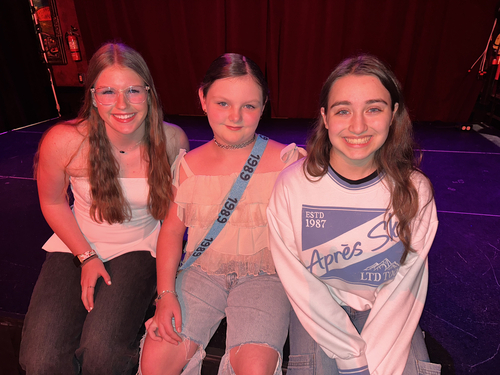
 On the way home from picking up dinner, everything felt normal. Jenna and her 10-year-old daughter, Eleanor, were laughing in the car, eating French fries and singing along to music. Then, as they turned onto their street, Eleanor suddenly became very serious. “Mom, my head hurts really bad,” she said.
Within minutes, the laughter was gone.
Jenna did not yet know that Eleanor had a brain tumor in her cerebellum that would quickly lead to a life-threatening medical emergency. As Eleanor’s condition worsened, Jenna rushed her to Memorial Hermann Katy Hospital, beginning a continuum of care that would span Memorial Hermann Life Flight®, Children’s Memorial Hermann Hospital, TIRR Memorial Hermann and ongoing rehabilitation at TIRR Memorial Hermann Pediatric Outpatient Therapy - Katy.
“This was the scariest night of our lives,” Jenna said. “But from the moment we arrived, we were surrounded by people who knew exactly what needed to happen. Every team worked together, and because of them, my daughter is still here.”
An Ordinary Night Changes in Minutes
Before everything happened, Eleanor was a curious kid who loved Taylor Swift, painting and sharing facts about outer space. She had always been somewhat anxious and careful, Jenna recalled, and looking back, she wonders whether some of that may have been connected to what was happening in Eleanor’s brain. But there were no clear warning signs before the night of her emergency.
At first, Jenna thought Eleanor might need medicine for a headache, but as she offered her ibuprofen, she realized something had changed. Eleanor’s face looked blank, her words were drawn out and slurred, and she kept saying she wanted to go to bed, even though it was before her bedtime. Shocked, Jenna immediately thought of stroke symptoms.
She drove Eleanor to the Children’s Memorial Hermann Pediatric Emergency Room at Memorial Hermann Katy Hospital and told the team at the front desk what she was seeing. As a designated Level III Trauma Center that is in active pursuit of a Trauma Level II designation, Memorial Hermann Katy is equipped to provide advanced trauma life support, evaluation, stabilization and diagnostic services.
The team responded immediately. Before Eleanor was fully checked in, staff began assessing her face, speech and other neurological signs. A CT scan soon showed bleeding in her brain. At that point, the team recognized she had a brain hemorrhage and needed the highest level of pediatric specialty care right away.
After the CT scan, Jenna saw one of Eleanor’s emergency physicians run down the hallway. “I will always remember that moment, and I’m forever grateful for watching that man run like he was saving his own child,” Jenna said.
He was coordinating Eleanor’s emergency transfer across town.
A Seven-Minute Flight to Children’s Memorial Hermann Hospital
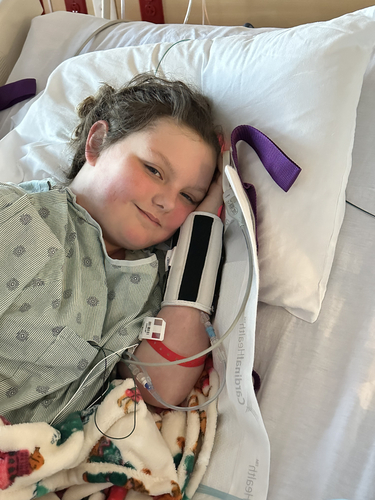
Jenna and Eleanor arrived at Memorial Hermann Katy around 9 p.m. Before midnight, Eleanor was transported by Memorial Hermann Life Flight® to Children’s Memorial Hermann Hospital in the Texas Medical Center.
The flight from Katy to the Texas Medical Center took about seven minutes. For Jenna and her husband, the drive took closer to 40 minutes. On the way, Jenna could see Eleanor’s helicopter in the sky, flying ahead of them toward the specialty care her daughter urgently needed.
Memorial Hermann Life Flight® is a critical care air medical service that provides emergency transportation within a 150-mile radius of the Texas Medical Center. Its fleet is equipped to care for critically ill and injured adult and pediatric patients in flight, with specialized crews, advanced emergency equipment and medications on board.
By the time Jenna arrived at Children’s Memorial Hermann Hospital, Eleanor had already undergone additional imaging to confirm what the Katy team had seen. The bleeding in her brain was creating dangerous pressure and fluid buildup, and physicians explained that surgery could not wait.
Manish N. Shah, MD, professor and director of Pediatric Neurosurgery at McGovern Medical School at UTHealth Houston and Children's Memorial Hermann Hospital, was the surgeon on call that night. In a moment when everything felt terrifying and uncertain, Jenna said his calm confidence helped steady the family.
Eleanor’s surgery began around 1 a.m. Over the next several hours, Jenna received updates from the operating room while Dr. Shah and the surgical team worked to relieve the pressure in Eleanor’s brain and address the bleeding.
Two Brain Surgeries in Three Days
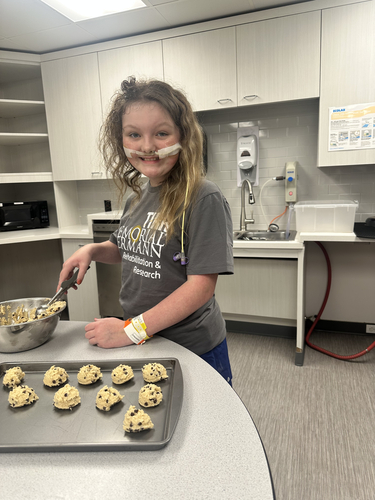
Eleanor, who spent her next several hours in surgery, was diagnosed with a cerebellar pilocytic astrocytoma, a brain tumor that most commonly occurs in children and young adults. In Eleanor's case, the tumor had grown in her cerebellum, the part of the brain that helps control balance, coordination and movement. Although the tumor was noncancerous, it had begun to bleed, causing clotting and pressure near the brain stem.
“Eleanor arrived in a critical, life-threatening situation,” said Dr. Shah. “The bleeding had caused swelling near the brain stem and hydrocephalus, meaning fluid was building up in the brain and could not flow normally. At that point, we needed to reduce the swelling, address the hemorrhage and stabilize her so we could determine the safest path forward.”
During the first surgery, Dr. Shah and the surgical team relieved pressure in Eleanor’s head by removing large blood clots and placing a drain to manage fluid buildup. They also collected tissue to better understand what had caused the bleeding.
Over the next two days, the team monitored Eleanor closely, reviewed initial pathology results and determined how best to treat the tumor itself. Because the tumor had already bled and caused major symptoms, surgically removing it offered the safest path forward.
Two days later, Eleanor underwent a staged surgery to remove the tumor and repair the area where the skull had been opened. The team then replaced the bone flap and secured it with titanium plates.
Dr. Shah explained that once the tumor was removed and Eleanor was medically stable, the next priority was helping her brain and body recover from everything she had been through.
Eleanor had gone from singing in the car with her mom to two brain surgeries in three days. There was no time for the family to prepare, but there was a team around her that moved with urgency, precision and purpose. With Eleanor’s surgeries complete, the focus began to shift toward her recovery.
Relearning to Walk, Dance and Shoot Hoops
 The days immediately following her surgery were spent in the Pediatric Intensive Care Unit at Children’s Memorial Hermann Hospital. There, Eleanor received close monitoring and specialized support as her care team helped her begin the next phase of recovery.
The first few days were quiet and difficult, with Eleanor sleeping often as her body began to recover. When she woke more fully, she recognized her family, smiled and could speak, but the tumor and bleeding had affected key functions, including walking, swallowing, speech, coordination, balance and fine motor skills.
Even before her transfer to TIRR Memorial Hermann, rehabilitation therapy began at Children’s Memorial Hermann Hospital, helping Eleanor work on standing, walking, swallowing, forming words and using her hands. In those early sessions, the care team also found ways to bring Eleanor’s personality into recovery. She listened to music, remembered lyrics and played keyboard, including Taylor Swift songs she knew from memory.
For Jenna, those moments were remarkable as she realized the parts of Eleanor’s personality that her family knew and loved were still there.
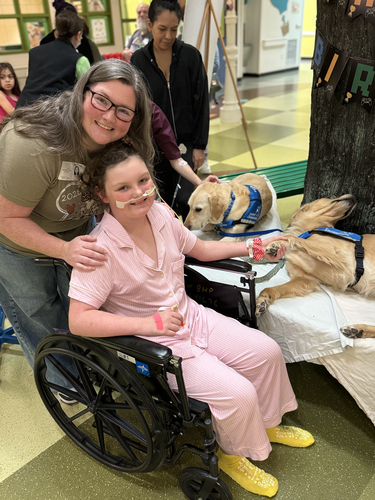
After about two weeks at Children’s Memorial Hermann Hospital, Eleanor was moved to TIRR Memorial Hermann in the Texas Medical Center. There, inpatient, pediatric rehabilitation is built around the physical, emotional and developmental needs of children recovering from serious injuries, illnesses and neurological conditions. For Eleanor, that meant daily physical, occupational and speech therapy, along with physician, nursing, neuropsychology and Child Life support, including frequent visits with Annie and Pilot, TIRR Memorial Hermann’s two facility dogs.
Seeing how much Eleanor connected with the experience, Jenna described TIRR Memorial Hermann as “rehabilitation summer camp for the kids.” The days were structured and demanding, but the environment was designed to keep children engaged, with group activities, outings and personalized therapy tied to each child’s individual interests.
Because Eleanor loved hip-hop dance and had taken classes on Tuesdays before her hospitalization, her occupational therapy team incorporated hip-hop into her Tuesday sessions. “After a brain injury, pediatric rehabilitation is about helping a child relearn skills while helping them stay connected to the interests and routines that motivate them,” said Simra Javaid, DO, an assistant professor of Physical Medicine and Rehabilitation at McGovern Medical School at UTHealth Houston and pediatric physical medicine and rehabilitation physician affiliated with TIRR Memorial Hermann. “For Eleanor, that meant intensive therapy to address balance, coordination, speech, swallowing and independence.”
One unexpected part of Eleanor’s recovery was basketball. In the pediatric gym, she gravitated toward a Pop-A-Shot game. She had never been especially interested in sports before, but shooting baskets became something rewarding, physical and fun.
Then basketball became part of her story in an even bigger way. During a physical therapy walk-through, the elevator doors opened and there stood a member of the Houston Rockets basketball team who just happened to be in the hospital visiting a friend. Jenna asked for a picture and Eleanor was thrilled!
For Eleanor, the moment became a bright spot in a long recovery. During this time, her family also attended a Houston Rockets game and was able to cheer on the team.
Once Eleanor was discharged, her recovery continued at TIRR Memorial Hermann Pediatric Outpatient Rehabilitation – Katy on the same Katy campus where her care journey began. Today, she attends therapy four days a week and has returned to school half-days.
During one recent visit to the hospital, Eleanor and her family had the chance to thank the team who first cared for her during the emergency. It was an emotional moment and a chance to bring some joy back to the place where her care journey had begun.
Continuing Recovery Close to Home
Eleanor’s recovery is still unfolding, with follow-up scans, therapy appointments and milestones ahead. For Jenna, the experience has also become something she hopes can help other families who are facing a sudden, frightening diagnosis.
“For anyone going through something like this, ask questions, advocate and trust the team around you,” Jenna said. “It is definitely terrifying, and people will tell you to take care of yourself when that feels impossible. But even if it is just stepping outside for 15 minutes or eating a meal in the lobby, take those moments. You need them so you can keep showing up for your child.”
Eleanor’s story began with a sudden headache after an ordinary night with her mom. It continued through a seven-minute flight, two brain surgeries, inpatient rehabilitation and outpatient therapy. At every step, Memorial Hermann teams across Greater Houston stayed connected, prepared and ready for what came next. Today, Eleanor is healing and becoming more like herself every day.

Nationally Ranked Rehabilitation
For the 37th consecutive year, TIRR Memorial Hermann is recognized as the best rehabilitation hospital in Texas and No. 4 in the nation according to U.S. News and World Report's "Best Rehabilitation Hospitals" in America.
Learn more about TIRR Memorial Hermann rankingsContact Us
If you have questions or are looking for more information, please complete the form below and we will contact you.