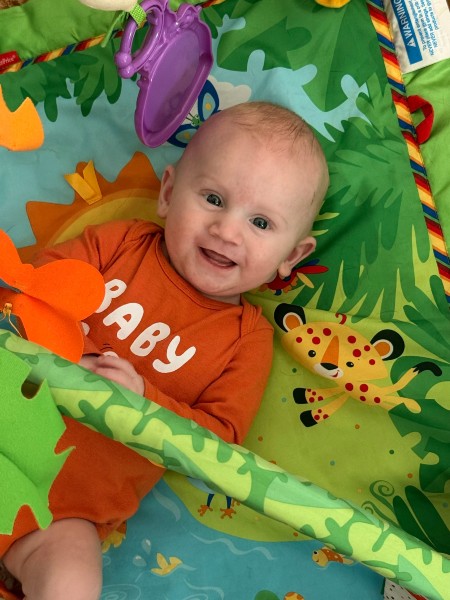
 When Madison and Chris Wilcox of the Dallas area learned they were expecting their first child, they never imagined their parenthood journey would take so many twists and turns in such a short time. But despite all of the ups and downs, their son Cash is thriving, thanks to the Congenital Diaphragmatic Hernia (CDH) program and care team affiliated with Children’s Memorial Hermann Hospital.
A Devastating Diagnosis Early in Pregnancy
In December 2024, at 13 weeks pregnant, Madison underwent genetic testing with her Maternal-Fetal Medicine team in Dallas. While providers noted something unusual at the time, they waited to discuss their concerns until a follow-up visit. At 16 weeks, Madison learned her baby might have a left-sided congenital diaphragmatic hernia (CDH), a rare and serious condition in which a hole in the diaphragm allows abdominal organs to move into the chest, preventing the lungs from developing properly.
“Hearing those words was scary, like the ground shifting beneath us,” said Madison. “We quickly went from planning what Cash’s nursery would look like to wondering if he would even survive.”
Because CDH can restrict lung growth before birth, Madison’s care team began evaluating whether she might be a candidate for a specialized fetal intervention to help promote lung development.
Turning to a Leader in Fetal and CDH Care
Families from across the country turn to Children’s Memorial Hermann Hospital for its nationally recognized specialty care for babies with CDH. The Comprehensive Center for CDH Care, affiliated with Children’s Memorial Hermann Hospital and McGovern Medical School at UTHealth Houston, brings together decades of experience, advanced technology, forward-thinking research and a multidisciplinary team to provide seamless, unmatched care from diagnosis through long-term follow-up.
Because CDH can severely limit lung development before birth, some babies may benefit from specialized fetal intervention to improve their chances of survival.
Madison’s care team in Dallas referred her to The Fetal Center at Children’s Memorial Hermann Hospital, affiliated with UTHealth Houston, in the Texas Medical Center. The Fetal Center is home to one of the most experienced fetal and CDH programs in the country and specializes in advanced fetal care. Soon after, Madison received a call from Anthony Johnson, DO, professor of Obstetrics, Gynecology and Reproductive Sciences at UTHealth Houston and co-director of The Fetal Center, who explained she might be a candidate for fetoscopic endoluminal tracheal occlusion (FETO).
This highly specialized fetal intervention is typically performed around 28 weeks of pregnancy and involves inserting a tiny balloon inside the baby’s trachea to stimulate lung growth before birth. The balloon temporarily blocks the airway, allowing fluid to build up in the lungs, which stimulates accelerated lung growth before birth.
Because the balloon blocks the trachea, it must be carefully removed before delivery and before the umbilical cord is cut so the baby can breathe safely after birth. The timing and coordination of both placement and removal are critical to the success of the procedure and the baby’s survival.
“Given the risks involved, it was vital that Madison remain within 30 minutes of our facility in case she needed immediate medical intervention,” said Dr. Johnson. “We also needed to remove the balloon before delivery, so if labor began unexpectedly or complications arose, she would already be nearby.”
Upon learning this, Madison and Chris moved from Dallas to Houston with less than 11 days’ notice. “We were grateful to Dr. Johnson and his team because the FETO surgery gave Cash’s lungs a chance to develop before he was born,” said Madison. “Without this care, he wouldn’t have stood a chance.”
The balloon was successfully placed at 27 weeks of pregnancy and removed several weeks later when Madison was just over 34 weeks pregnant. She then remained under close observation until delivery. At 37 weeks, her water broke just before she was to be induced, and baby Cash was born on May 27.
“Many times, with this procedure, babies are not carried to term,” explained Dr. Johnson. “But Madison was an exception and represents an ideal outcome for the FETO procedure.”
Neonatal and Surgical Care After Birth
After Cash was born, his lungs remained fragile, so he was immediately intubated and admitted to the hospital’s Level IV Neonatal Intensive Care Unit (NICU) under the care of Matthew Harting, MD, William J. Devane Professor of Pediatric Surgery at UTHealth Houston and an affiliated pediatric surgeon at Children’s Memorial Hermann Hospital.
Within a week, Dr. Harting performed Cash’s CDH repair surgery. Cash had a left-sided congenital diaphragmatic hernia that required patch repair, and despite the severity of his defect, he did not require extracorporeal membrane oxygenation (ECMO) support. ECMO is a heart-lung bypass machine that allows the baby’s lungs to rest and heal.
“We consider many factors when determining the optimal timing for CDH repair, and Cash handled the surgery very well,” said Dr. Harting. “He had the largest defect with almost zero diaphragm, though he did not need ECMO, which may represent a benefit of the FETO procedure.”
“His situation was more severe than the scans initially had shown; his diaphragm hadn’t formed at all,” said Madison. “But the team never wavered. They gave us so much hope and confidence.”
After 63 days in the NICU, Cash was ready to go home. Madison and Chris breathed a sigh of relief.
But they were not out of the woods. “As we were leaving, Cash coded in his car seat,” Madison said. “Everyone came running and I’m convinced that their quick actions saved his life.”
Cash’s doctors determined that severe reflux caused him to aspirate. Following the event, he underwent surgery for placement of a gastrostomy tube (G-tube) and fundoplication, procedures designed to provide safe nutrition while preventing reflux and protecting his airway.
After four more weeks in the hospital, Madison, Chris and Cash were finally able to go home to Dallas.
Thriving Today with Lifelong, Specialized CDH Care
Today, Cash is healthy and strong, meeting every developmental milestone and growing quickly, with regular appointments with an occupational therapist and his pediatrician.
Through the hospital’s Comprehensive Center for CDH Care, Cash continues to receive coordinated follow-up care every few months, a vital part of his long-term health and development.
“The whole team was incredible,” said Madison. “We weren’t just a number. They treated us like family. It was evident how much every nurse and doctor truly cared.”
Despite moving twice within a year, the Wilcox family says they are deeply grateful for the care their son received. For Madison and Chris, that continuity of care has made all the difference.
“Looking back, we can’t imagine going anywhere else,” said Madison. “Because of the team at Children’s Memorial Hermann Hospital, our son is here—happy, healthy and full of life.”
Contact Us
To contact Children's Memorial Hermann Hospital, please fill out the form below.
If you are experiencing a medical emergency, call 911 or go to the nearest emergency room.
If you or someone you know needs support from the Suicide and Crisis Lifeline, call or text 988.