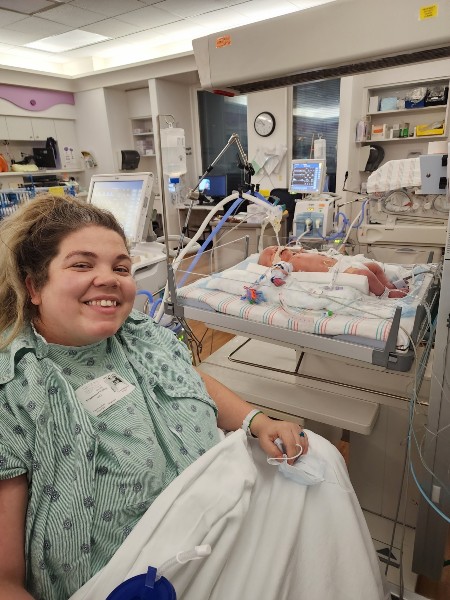
 Lauren was 21 weeks pregnant with her second child, Brooks, when she went in for her routine anatomy scan. Everything about the pregnancy had been typical so far—normal blood pressure checks, scale readings, urine tests and heartbeat appointments. It all felt so routine that she even told her husband, Nick, he didn’t need to come to “just another standard checkup and ultrasound.”
What happened next is every expectant mother’s fear: the possibility that something might be wrong.
“The ultrasound tech kept saying she couldn’t get a good reading,” Lauren recalled. “She couldn’t find the heart, lungs or stomach. They tried to make light of it at first and said maybe the organs were just hiding.”
Out of caution, Lauren’s obstetrician referred her to a high-risk specialist the following week. As the specialist began scanning, the room grew noticeably quiet. After about 45 minutes, Lauren tried to lighten the moment with a joke about the first tech having trouble. “Then the tech said, ‘I don’t have a hard time getting readings.’ That’s when I knew something was wrong,” she said.
When the doctor finally walked in, his first words confirmed her worst fear. “He asked what I knew about why I was there, then told me something was wrong with my baby’s heart. I was by myself, and I remember thinking, ‘Holy cow, something serious is happening.’”
The specialist explained that her baby’s chest appeared gray on the scan, which typically indicates one of two possibilities: a large tumor or the liver moved into the chest cavity and was pushing the heart out of place. “He told me the heart was in the armpit and the only way to know for sure was through an MRI,” Lauren said.
She soon learned that a specialized medical team in Houston had the experience and skillset to handle her case. With family nearby, Lauren chose to seek care at The Fetal Center at Children’s Memorial Hermann Hospital, affiliated with UTHealth Houston, in the Texas Medical Center.
The MRI confirmed that Brooks had congenital diaphragmatic hernia (CDH), a rare and serious condition that develops when the diaphragm does not form completely in early pregnancy, allowing abdominal organs to move into the chest cavity. This can limit lung growth and cause severe breathing challenges after birth. Nearly 69% of Brooks’ liver had migrated into the chest.
CDH occurs in about one in every 2,500 to 3,000 live births. Survival rates in the United States have improved significantly—now ranging from 65% to as high as 90%—particularly in centers like Children’s Memorial Hermann Hospital with specialized fetal, neonatal and surgical teams.
After receiving the diagnosis, Lauren and Nick quickly met their Houston care team. “Within a day or two, someone from The Fetal Center called me,” she said. “Her name was Nichole, and she walked me through everything. She scheduled a full day of appointments so I could meet the surgical team, the neonatologists, my new OB/GYN and the NICU team. That’s when I knew we were in good hands.”
Lauren also underwent genetic testing and an amniocentesis to rule out contributing factors. “The geneticist told us it wasn’t something we carried. It was multifactorial, just how the diaphragm formed,” she said.
At 34 weeks, Lauren relocated to Houston for close monitoring and to be near the hospital. She transferred her OB/GYN care to Jerrie S. Refuerzo, MD, professor of Obstetrics, Gynecology and Reproductive Sciences at McGovern Medical School at UTHealth Houston and an affiliated maternal-fetal medicine specialist at The Fetal Center at Children’s Memorial Hermann Hospital.
“Dr. Refuerzo was incredible. I had already had one C-section, so we decided to do another, ensuring the entire team would be ready and waiting,” said Lauren. “We scheduled the first surgery of the day so every doctor Brooks needed would be there.”
One moment that stayed with Lauren was how personally the team treated her unborn son. “When I told them his name, that was it—no one ever called him ‘the baby.’ They always said ‘Brooks.’ That meant everything to me,” said Lauren.
Even during moments of fear, Lauren felt supported. “The assistant to Dr. Refuerzo played music while they placed my epidural before delivery,” she said. “She treated me like a human, not just a patient.”
A Carefully Orchestrated Delivery
Brooks was born on Nov. 15, 2022, weighing 8 pounds, 13 ounces and measuring 20 inches long. He tried to breathe on his own, but his lungs couldn’t expand. Within 36 seconds, the Neonatal Intensive Care Unit (NICU) team intubated him.
“They got him stable enough to wheel him past me in a glass bassinet. We took a few photos and then he was gone. I didn’t get to hold him, but I felt at peace knowing everyone knew exactly what to do,” Lauren said.
Soon after, the team learned that Brooks’ condition was even more complex than expected. Although prenatal scans suggested a right-sided hernia, post birth imaging revealed that both sides were affected, with the liver blocking one side. This made his case extremely rare. Bilateral CDH occurs in only about 1% of all CDH diagnoses. Despite the severity, Brooks remained stable. Doctors had prepared Lauren and Nick for the possibility that he might need extracorporeal membrane oxygenation (ECMO) to help him breathe but fortunately, he never required it.
A National Leader in CDH Care
For more than 40 years, Children’s Memorial Hermann Hospital has been home to one of the most acclaimed, evidence-based and outcomes-driven CDH programs in the country. Families from across the region turn to the hospital’s Comprehensive Center for CDH Care, which brings together fetal specialists, neonatologists, pediatric surgeons, respiratory therapists and specialized nurses to provide coordinated care from diagnosis through long-term follow-up. The team’s depth of experience is especially crucial in complex and rare cases like Brooks.
“CDH is one of the most complex conditions we treat, and no two babies are exactly alike,” said Matthew Harting, MD, William J. Devane Professor of Pediatric Surgery at UTHealth Houston and an affiliated pediatric surgeon at Children’s Memorial Hermann Hospital as well as medical director of the Congenital Diaphragmatic Hernia program. “Our entire team works together from the moment of diagnosis to give each mother and family the support they need and each child the best possible chance at survival, growth and long-term health.”
At just 6 days old, Brooks underwent surgery with Dr. Harting, alongside a nurse practitioner in the pediatric surgery department and clinical and research coordinator for the CDH program.
During the operation, Dr. Harting and his team carefully moved Brooks’ abdominal organs—including his liver—back into their proper position and reconstructed both sides of his diaphragm. This meticulous repair is essential to allow the lungs the space they need to grow and function after birth and is a hallmark of the hospital’s specialized approach to caring for patients with CDH.
“Dr. Harting personally called me during the surgery to say everything was going well,” Lauren said. “I started sobbing right there. Afterward, he showed me photos and explained how the hernia was repaired. I felt like he treated Brooks as if he were his own son.”
Healing in the NICU
In the hospital’s Level IV NICU, Brooks’ care was led by Amir Khan, MD, professor of Pediatric Medicine at UTHealth Houston and medical director of the NICU at Children’s Memorial Hermann Hospital, along with Suzanne Lopez, MD, professor of Neonatal-Perinatal Medicine at UTHealth Houston and an affiliated neonatologist at Children’s Memorial Hermann Hospital. Dr. Khan and Dr. Lopez closely oversaw Brooks’ progress and helped guide Lauren and Nick through each step of his care.
“I sat in for rounds every morning,” Lauren said. “The doctors would talk with the nurses using medical terms, then turn to me and explain everything in simple language. They always asked how I was doing and if I had any questions.”
Lauren found comfort in one particular phrase from Dr. Khan. “He said, ‘We’re not driving the bus. Your baby is driving the bus, and we’re just making sure the road is safe.’ It reminded me to take things one day at a time.”
The family spent Thanksgiving and Christmas in the NICU. “Even with eight babies in our pod, every nurse and doctor treated each one like they were the only baby there,” she said.
Lauren often texted their liaison, Leigh Ann Cutting, the hospital’s pediatric patient care navigator, who supported the family through every phase of Brooks’ care. “I remember once texting her a question, and an hour later she was standing beside me in the NICU,” Lauren said. “She even had lunch with me a few times at the Ronald McDonald House. The care went beyond medicine.”
Small Victories and Meeting Big Milestones
 Feeding was Brooks’ biggest challenge. After weeks on a ventilator and tube feedings, he had to learn how to suck, swallow and breathe on his own. “It wasn’t a straight line. Some days he’d take 15 milliliters, the next day only two. It was exhausting,” Lauren said.
The care team suggested placing a G-tube so Brooks could continue feeding and gaining strength at home. “We decided to do it, and it ended up being a blessing because it gave him time to get better at feeding on his own,” she said.
After 61 days in the NICU, Brooks went home. “They told us to expect four to six months, so we were overjoyed,” Lauren said. “But I also felt guilty that our stay was shorter than other families.’ Leighann told me not to compare journeys and that helped me let go of that guilt.”
At home, Brooks gradually began taking more feedings by mouth. Within five weeks, he no longer needed the G-tube. By September 2023, it was officially removed. “That was the first time I saw my son without any medical equipment,” Lauren said. “No oxygen, no tubes, nothing. It was surreal.”
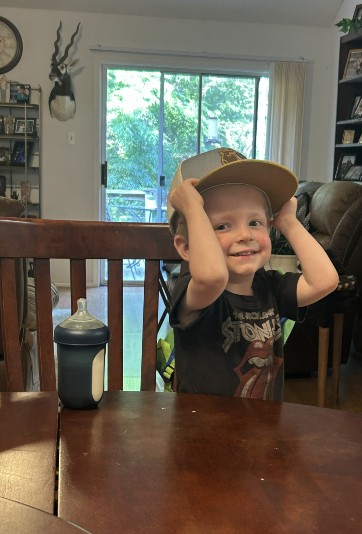
Brooks continued physical and speech therapy to help him reach milestones. He took his first steps at 15 months. Now three years later, he is full of energy. “He runs around the house saying, ‘Come and get me!’ and plays with his trucks,” Lauren said. “He even put one of his stuffed animals in a dump truck and yelled, ‘Ready to roll!’”
When her daughter, Charli, now 6 years old, noticed his scar, she asked about it. “I told her it was from his surgery,” Lauren said. “She looked at it and said, ‘It looks like a rainbow.’ That’s what we call it now, his rainbow scar.”
Lauren often reflects on the doctors and nurses who changed their family’s life. “They did everything they could to make Brooks perfect,” she said. “They didn’t just treat a diagnosis, they treated a little boy. They made it clear that he was loved and wanted.”
She also wants to help other families facing CDH know that hope is possible. “Ask questions, trust your team and remember you are part of the process,” she said. “Do your best to make decisions that feel right for you and your baby, so you never have to look back and wonder ‘what if.’”
Lauren has a message for the care teams who dedicate their lives to these children.
“Thank you for being so selfless in your passion for pediatric patients. Thank you for making it obvious how important these babies are.”
Contact Us
To contact Children's Memorial Hermann Hospital, please fill out the form below.
If you are experiencing a medical emergency, call 911 or go to the nearest emergency room.
If you or someone you know needs support from the Suicide and Crisis Lifeline, call or text 988.