It was Jaclyn’s father’s birthday. She was in the passenger seat on the way to lunch when the accident happened.
Her mother, Sheri, a school principal in El Paso, had just left her campus to meet her. They had been texting. Then, suddenly, Jaclyn stopped responding.
When the hospital called and asked if she knew the young man who had been driving, Sheri knew that something was very wrong.
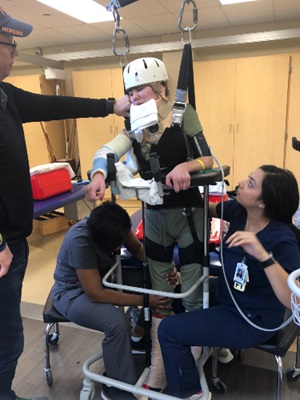 Jaclyn was not expected to survive the night, but she proved everyone wrong.
To relieve the pressure on her brain, surgeons removed the right side of her skull. Three days later, when the swelling continued, they removed the left side as well. For months, her brain had no protective skull. A shunt was placed. A tracheotomy. A feeding tube. Her broken leg was repaired. And for two and a half months, Jaclyn remained in a coma.
Her family began searching for a rehabilitation facility capable of taking on a case this complex. They turned to social media, asking anyone who might know where to go. “TIRR Memorial Hermann,” was the answer that continued to float to the top.
They booked a flight and came to Houston, where Jaclyn was admitted into the Disorders of Consciousness program, one of the most specialized rehabilitation pathways in the country.
When they arrived, Jaclyn was still in and out of consciousness, with both sides of her skull missing. Sheri had packed workout clothes anyway.
The team at TIRR Memorial Hermann had a plan: they were going to get her out of bed.
For the first time in three and a half months, Jaclyn was dressed in real clothes. The team began the careful work of finding a way into Jaclyn’s mind, holding up objects, searching for even the smallest sign of response. Sheri suggested something familiar: her cell phone and her mascara.
Jaclyn’s first intentional movement was scrolling her phone with her thumb.
Soon after, she began reaching out toward a stuffed animal that resembled her dog, Chloe, believing it was real. It was a beginning.
Jaclyn and her family remained at TIRR Memorial Hermann for four and a half months.
The road home was long. Jaclyn did not speak for a year. She relied on a feeding tube for 14 months. She did not walk for two and a half years. At one point, she managed 13 medications, including anti-seizure drugs. Her skull implants—custom 3D-printed in Germany—required multiple surgeries due to complications and infection.
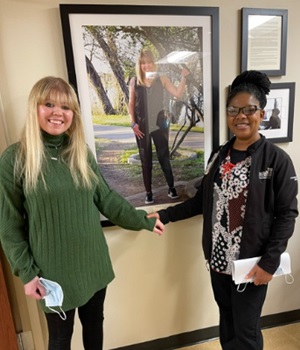 Doctors told her she would likely need a shunt for life. In September, it was turned off and has remained off ever since. Today, Jaclyn is off all medications.
She is in college. She is driving. And she is studying to become a neuropsychologist, inspired by the one who helped guide her recovery at TIRR Memorial Hermann.
Today, Jaclyn and her family have turned their experience into a source of support for others—showing up for families in their hardest moments, sharing what they’ve learned and helping them find a path forward. They speak across the country and remain a steady voice for those navigating the unknown.
When asked what she would say to someone facing what she once did, Jaclyn doesn’t hesitate.
“Never give up. Just keep fighting. And pray.”