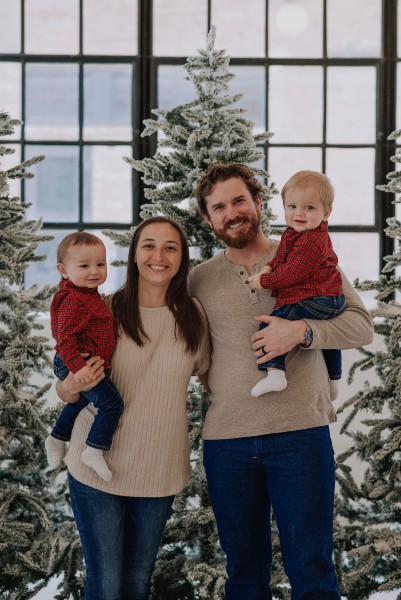
 It was Friday night in Pearland, Texas, and Katie Carter and her husband, Nathan, were preparing for their weekly pizza night. Family was coming over soon, and it was shaping up to be a typical evening at home with their 18-month-old twin boys.
Instead, what began as a severe headache for Katie quickly turned into a life-threatening stroke.
Within hours, Katie would receive emergency treatment at Memorial Hermann Southeast Hospital, be airlifted by Memorial Hermann Life Flight® to Memorial Hermann-Texas Medical Center and undergo a complex neurointerventional procedure to restore blood flow to her brain.
Less than a week later, she was back home with her family.
Katie only remembers the headache. What happened that night, and the following week, has been told to her by family members. It’s still difficult for her to believe their accounts of what happened. "I only know one thing for certain," Katie said. "It was thanks to quick action by my family and the advanced stroke team at two Memorial Hermann hospitals that I'm alive today."
Stroke Symptoms Strike During an Ordinary Family Evening
At 31 years old, Katie did not fit the profile many people associate with stroke. An active young mother balancing work and family life, she never imagined she would face a neurological emergency.
But Katie and her family now know that stroke can happen at any age.
Nathan first noticed something was wrong when Katie began struggling with simple tasks. She had difficulty using her hands and seemed increasingly confused. By late afternoon, her speech had become slurred.
Concerned, he called Katie's mother, Maria Guerrettaz, who lives nearby. "When I walked in, Katie was on the floor," Maria recalled. "She was talking gibberish. She complained of severe neck pain and a terrible headache."
Despite hearing a high-pitched ringing sound, Katie insisted she was fine. She even attempted to continue preparing food for her boys. But when Nathan and Maria watched her struggle with tasks she normally performed with ease, they knew she needed immediate medical attention.
Recognizing the Warning Signs of Stroke
Within minutes, Katie's Aunt Sylvia arrived. A nurse with the Memorial Hermann who lives in the same neighborhood as the Carters, Sylvia immediately recognized that Katie's symptoms could indicate a serious neurological event.
"Sylvia said something was seriously wrong, which we already knew," Maria said. "That's when we insisted Katie go to the ER with Nathan or we would call an ambulance."
Reluctantly, Katie agreed.
That decision likely saved her life.
Stroke specialists often use the phrase "Time is brain" because brain cells begin dying within minutes when blood flow is interrupted. Rapid diagnosis and treatment can help preserve brain function, reduce disability and improve outcomes.
Memorial Hermann encourages people to remember the acronym BE FAST when recognizing the warning signs of stroke:
Balance – Sudden loss of balance, coordination or dizziness
Eyes – Sudden vision changes
Face – Facial drooping or uneven smile
Arms – Arm weakness or numbness, especially on one side
Speech – Slurred speech or difficulty communicating
Time – Call 911 immediately
Katie's family did not know exactly what was happening, but they recognized something was seriously wrong and acted quickly.
Emergency Stroke Care Begins at Memorial Hermann Southeast
By the time Katie arrived at Memorial Hermann Southeast, her condition had deteriorated significantly.
Physicians immediately activated stroke protocols and began a comprehensive neurological evaluation.
As part of Memorial Hermann's integrated stroke network, Memorial Hermann Southeast is equipped to rapidly identify stroke patients, administer emergency therapies and coordinate transfers when advanced neurovascular intervention is needed.
Imaging studies ruled out bleeding in the brain, allowing physicians to administer TNK (Tenecteplase), a clot-busting medication used to restore blood flow during certain types of stroke.
Shortly afterward, Katie experienced a seizure.
To protect her airway and support breathing, physicians intubated her and placed her on a ventilator.
Given the complexity of her condition, the stroke team arranged rapid transport by Life Flight helicopter to Memorial Hermann-Texas Medical Center, home to one of the region's most advanced stroke programs.
Memorial Hermann Specialists Uncover a Rare Cause
At Memorial Hermann-Texas Medical Center, stroke specialists continued searching for the underlying cause of Katie's symptoms.
An angiogram revealed a rare and potentially devastating condition: tears affecting both her carotid and vertebral arteries.
Known as arterial dissections, these tears in the inner lining of an artery can disrupt blood flow to the brain and significantly increase the risk of a stroke.
Katie's care team quickly identified the source of the problem and developed a treatment plan.
Arterial dissections are uncommon but can have serious consequences when they interrupt blood flow to the brain. Rapid diagnosis, advanced imaging and timely intervention are critical to restoring circulation and helping patients achieve optimal outcomes.
Advanced Neurointerventional Treatment Restores Blood Flow
The carotid and vertebral arteries are major blood vessels that deliver oxygen-rich blood to the brain.
To stabilize the damaged vessels and restore circulation, specialists performed a complex neurointerventional procedure, placing four stents within the affected arteries. The minimally invasive procedure helped reopen critical blood vessels and reduce the risk of additional neurological injury.
Following the procedure, Katie remained under close observation in the Neuroscience Intensive Care Unit.
Physical and occupational therapists evaluated her recovery and monitored for any lingering deficits. For Katie, that coordinated multidisciplinary care meant she could focus on returning to her most important role: being a mother to Jameson and Colten.
A Comprehensive Stroke Network Designed for Emergencies
Katie's recovery highlights the strength of Memorial Hermann's coordinated stroke system, which connects community hospitals with its renowned stroke program.
Memorial Hermann-Texas Medical Center is home to a Comprehensive Stroke Center, the highest level of stroke certification. The designation recognizes hospitals capable of treating the most complex stroke and neurovascular emergencies using advanced imaging technology, neurointerventional procedures and highly specialized expertise available around the clock.
Memorial Hermann Southeast also plays a critical role in the system’s coordinated stroke network, enabling patients to receive rapid evaluation, clot-busting medications and seamless transfer when advanced intervention is needed.
Patients benefit from rapid stroke evaluation, evidence-based treatment protocols and seamless access to specialized care when advanced intervention is required.
For Katie, that meant receiving lifesaving treatment close to home and then rapidly transferred to a higher level of care for diagnosing and treating the underlying cause of her stroke.
"The care Katie received was 10 out of 10," Maria said. "The protocols they had in place helped her tremendously. They knew exactly what they needed to do and they did it."
Back Home with Her Family in Less Than a Week
Just days after being flown by helicopter to the Texas Medical Center, Katie was back home with her husband and twin boys.
Today, she enjoys spending time outdoors with her family, cheering on the Houston Texans and keeping up with two energetic toddlers. Her experience serves as a powerful reminder that stroke can happen to anyone—even healthy younger adults.
For Katie and her family, the outcome could have been very different.
Instead, rapid recognition of stroke symptoms, immediate treatment at Memorial Hermann Southeast and advanced neurovascular intervention at Memorial Hermann-TMC gave her the opportunity to reclaim her active life..
When every minute counts, access to experienced stroke specialists and a coordinated system of care can save lives. It saved Katie’s.
Katie’s stroke was ultimately caused by a carotid artery dissection, a tear in one of the major arteries supplying blood to the brain. While her condition was uncommon, her experience reinforces an important message: no one is too young to recognize stroke symptoms and seek immediate medical attention.
Knowing the warning signs and acting quickly can make all the difference.